The Monetary Policy Committee (MPC) of the Reserve Bank of India (RBI) on 8th June 2022, unanimously decided to raise the policy repo rate by 50 basis points (bps), the steepest increase in more than nine years, to 4.9 per cent. This is the second hike in the repo rate in just over a month, adding up 90 bps from 4 per cent set in May 2020, with a view to controlling inflation, aggressively. While the RBI was behind the curve to control inflation till the April MPC meeting, it took a decisive step to control spiraling inflation by raising the first repo rate hike in two years by 40 bps in the off-cycle MPC meeting on 4th May 2022.
The MPC has increased the inflation forecast by 100 bps to 6.7 per cent for fiscal year (FY) 2022-23, and has projected an inflation rate of 7.5 per cent, 7.4 per cent, and 6.2 per cent for Q1, Q2 and Q3 of FY23, respectively. For the first time since the flexible inflation-targeting framework was introduced in October 2016, for policy repo rate setting by the MPC, the RBI, in all likelihood, will fail to achieve its mandate – which is to keep the average inflation at 4 per cent with a +/- 2 per cent tolerance limit – for three consecutive quarters. As per the mandate, RBI would need to explain to Government of India the reasons for inflation exceeding the upper tolerance limit of 6 per cent for three consecutive quarters.
Inflation is now a global phenomenon, due to the Ukraine-Russia war, Covid-related lockdowns in China and global supply chain disruptions. As stated by RBI Governor Mr. Shaktikanta Das, “The war has led to globalisation of inflation. Not surprisingly, central banks are reorienting and recalibrating their monetary policies. Emerging market economies (EMEs) are facing bigger challenges from increased market turbulence, monetary policy shifts in advanced economies (AEs) and their spillovers. The process of economic recovery in EMEs is also getting affected”.
The MPC also decided to drop the accommodative stance to “remain focused on withdrawal of accommodation to ensure that inflation remains within the target going forward, while supporting growth”. As RBI has embarked on an aggressive policy tightening cycle, the MPC is expected to resort to calibrated tightening and could decide on two more hikes of 25 bps each in FY23, taking the repo rate to 5.65 per cent by March 2023.
However, there could arise a risk of a wide divergence from RBI’s inflation projections, which could result in a sharper rate hike. Research by SBI shows that RBI could factor in a rate hike in August and even October MPC meetings, and take the repo rate higher than pre-pandemic level by August to 5.25 per cent and in October to 5.5 per cent. The peak rate at the end of the cycle, according to the SBI report now has a lower bound of 5.5 per cent and could go up to 5.75 per cent, depending on inflation trajectory.
Banks have raised their lending rates in response to the rise in the repo rate. This will cause borrowers to pay higher equated monthly instalments for their loans. Further, the demand for loans by retail as well as corporate borrowers would fall, restricting economic activities.
The RBI, however, has kept its growth forecast unchanged at 7.2 per cent for FY23, with Q1, Q2 and Q3 growth at 16.2 per cent, 6.2 per cent, 4.1 per cent; and 4.0 per cent, respectively, with risks broadly balanced. According to the MPC statement, the recovery in domestic economic activity is gathering strength due to the following factors:
Rural consumption should benefit from the likely normal south-west monsoon and the expected improvement in agricultural prospects;
A rebound in contact-intensive services is likely to bolster urban consumption, going forward;
Investment activity is expected to be supported by improving capacity utilisation, the government’s capex push, and strengthening bank credit;
Growth of merchandise and services exports is set to sustain the recent buoyancy.
However, the MPC has warned that spillovers from prolonged geopolitical tensions, elevated commodity prices, continued supply bottlenecks and tightening global financial conditions nevertheless weigh on the growth outlook.
In the face of an unabated rise in inflation, the Monetary Policy Committee (MPC) of the Reserve Bank of India (RBI), in an off-cycle meeting held on 2nd and 4th May 2022, decided to raise the policy repo rate by 40 basis points (bps) to 4.4 per cent, and the cash reserve ratio (CRR) by 50 bps to 4.5 per cent. This is the first hike in repo rate after almost two years.
The timing of the hike came as a surprise to the financial markets, with the Sensex crashing by 1,307 points, or 2.29 per cent lower than the previous day’s close (3rd May 2022). However, it was expected by economists that the MPC would start raising the policy repo rate anytime soon during FY23, as CPI inflation remained above RBI’s tolerance level of 6 per cent during the three months January-March 2022. Inflation in March 2022 was much above the tolerance limit at 6.95 per cent. The inflation outlook remained grim in the context of rising food prices, apart from the rise in global prices of crude oil, wheat and sunflower oil due to global supply disruptions on account of the Russia-Ukraine conflict.
Further, the decision by Indonesia to ban exports of palm oil, due to fall in domestic production on account of labour shortage in the country, has resulted in a sharp rise in price of edible oils in India, which depends on imports from Indonesia for 60 per cent of its demand for palm oil.
The MPC in its previous meeting during 06-08 April 2022 had decided to remain accommodative while focusing on withdrawal of accommodation to ensure that inflation remains within the target going forward, while supporting growth. In its off-cycle meeting, the MPC using an almost similar language, continued to maintain an accommodative stance, while focusing on withdrawal of accommodation to ensure that inflation remains within the target going forward, while supporting growth.
The MPC has stated that inflation would “rule at elevated levels, warranting resolute and calibrated steps to anchor inflation expectations and contain second round effects”. Given RBI’s projection of 5.7 per cent inflation during FY23, which could well be revised upwards, it can be expected that the RBI would increase the policy repo rate going forward by 75 bps to touch the pre-pandemic level of 5.15 per cent by end March 2023. Further, the CRR hike by 50 bps will result in an upward pressure on interest rates while withdrawing system liquidity by an additional INR 87,000 crore.
While loans to retail and micro, small and medium enterprises (MSME) borrowers, linked to the policy repo rate will become costlier with immediate effect, interest rates on corporate loans will rise within a month or so. Following the decision of the RBI to raise the policy repo rate, Bank of Baroda and ICICI Bank raised their external benchmark-linked lending rates by 40 bps each.
While costlier loans to productive sectors would have an adverse impact on India’s growth prospects, the country can still maintain its position as the fastest growing large economy in the world, with the government having prioritized investment in infrastructure, while also carrying forward its agenda of structural reforms, in addition to a focus on export-oriented manufacturing through the production linked incentive (PLI) scheme, and investment in education and health.
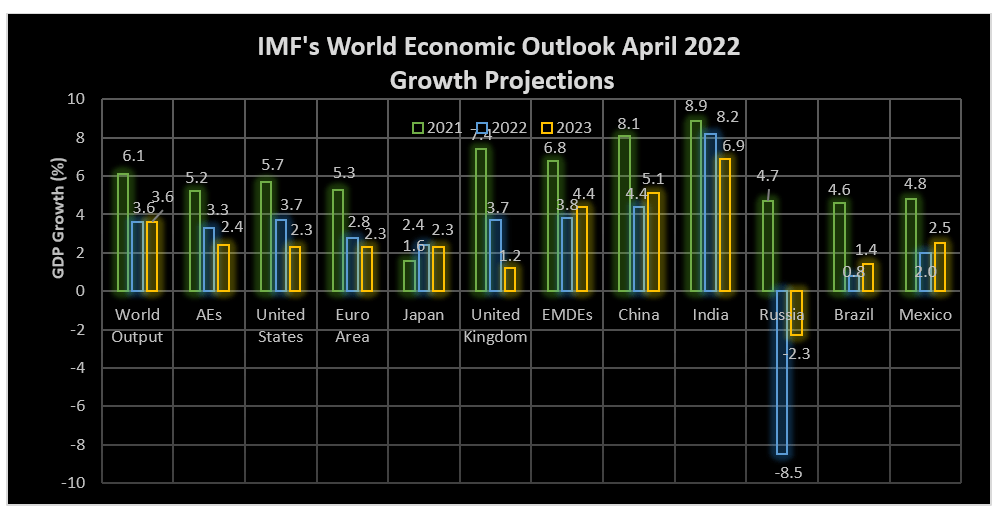
The International Monetary Fund (IMF) in its April 2022 edition of the World Economic Outlook (WEO) has projected the global economy to slow down sharply from 6.1 percent in 2021 to 3.6 percent in 2022 and 2023. The projections are 0.8 and 0.2 percentage points lower for 2022 and 2023, respectively, made in the January 2022 WEO Update.
Beyond 2023, global growth is forecast to decline to about 3.3 percent over the medium term. The sharp cut in growth projections is the result of the humanitarian and economic impact of Russia-Ukraine war, and the sanctions against Russia imposed by the United States (US) and its allies. Crucially, the projections by IMF assume that the conflict remains confined to Ukraine, further sanctions on Russia exempt the energy sector and the pandemic’s health and economic impacts weaken during 2022. Further, employment and output will remain below pre-pandemic trends through 2026, with few exceptions.
The IMF warns that unusually high uncertainty surrounds the growth forecast, and downside risks to the global outlook dominate—including from a possible worsening of the war, escalation of sanctions on Russia, a sharper-than-anticipated deceleration in China from 8.1 per cent in 2021 to 4.4 per cent in 2022. Moreover, the war in Ukraine has increased the probability of wider social tensions because of higher food and energy prices, which would further weigh on the outlook.
The advanced economies (AEs) are expected to slow-down sharply from 5.2 per cent in 2021 to 3.3 per cent in 2022 and 2.4 per cent in 2023, as shown in the chart below. The US is expected to witness a sharp fall in growth from 5.7 per cent in 2021 to 3.7 in 2022 and 2.3 per cent in 2023. The Euro area, too, is estimated to slowdown from 5.3 per cent in 2021 to 2.8 per cent and 2.3 per cent in 2022 and 2023, respectively.
The growth of emerging market and developing economies (EMDEs) is expected to fall sharply from 6.8 per cent in 2021 to 3.8 per cent in 2022, but would rise to 4.4 per cent in 2023. The projected growth rates for AEs as well as EMDEs have been downgraded from the projections made by the IMF in October 2021 and January 2022, in view of the ongoing Russia-Ukraine war, disruption in global supply chains and unprecedented world-wide inflationary situation.
The IMF downgraded India’s growth forecast for FY23 from 9 per cent estimated in January 2022 to 8.2 per cent, citing the impact of high oil prices on consumer demand and private investments. The forecast for India by the IMF is among the most optimistic so far. While the RBI lowered India’s growth projection for FY23 from 7.8 per cent estimated earlier to 7.2 per cent in the latest Monetary Policy Committee (MPC) meeting (06-08 April 2022), the World Bank reduced India’s growth forecast from 8.7 per cent estimated in January 2022 to 8 per cent, recently. However, India is projected to remain the world’s fastest-growing major economy by the IMF, the World Bank and the OECD. But we live in an uncertain world, and the actual growth could end up below the projections.
The IMF has identified the following five principal forces that would shape the near-term global outlook:
The war in Ukraine
The economic damage will lead to a significant slowdown in global growth in 2022 – a severe double-digit drop in GDP for Ukraine and an 8.5 per cent contraction in Russia, along with spillovers across the world through commodity markets, trade, and financial channels.
Monetary tightening and financial market volatility
Significant rise in inflation in major economies has led to tightening of monetary policy by central banks. This has contributed to a rapid increase in nominal interest rates across advanced economy sovereign borrowers. In the months ahead, policy rates are generally expected to rise further and central banks would begin to unwind balance sheets in AEs and also in several EMDEs. Capital outflows from EMDEs have led to sharp fluctuations in the financial markets in these economies. Further, the financial markets across the globe have been experiencing sharp fluctuations due to the imminent rise in US Fed rates.
Fiscal withdrawal
Policy space in many countries has been eroded by necessary higher COVID-related spending and lower tax revenue in 2020–21. Faced with rising borrowing costs, governments are increasingly challenged by the imperative to rebuild buffers.
China’s slowdown
Deceleration in China’s economic growth has wider ramifications for Asia and for commodity exporters.
Pandemic and vaccine access
Restrictions have begun to ease as the peak of the Omicron wave passes and global weekly COVID deaths decline. The risk of infection leading to severe illness or death appears lower for the dominant Omicron strain than for others—especially for the vaccinated and boosted. The health and economic impacts of the virus are expected to start to fade in the second quarter of 2022.
India’s Wholesale Price Index (WPI) inflation surged to a 4-month high of 14.55 per cent in March 2022, which was a sharp rise from 13.11 per cent in the previous month. This was the result of an unfavourable base effect (1.3 per cent in March 2021) and broad-based rally in global commodity prices, especially crude oil, due to the Russia-Ukraine conflict. With this, WPI remained in double digits throughout FY22. The average inflation at 12.94 per cent in FY22 is the highest in three decades.
While wholesale food inflation rate eased sequentially from 8.19 per cent to 8.06 per cent in March 2022, vegetable inflation dropped sharply from 26.93 per cent in the previous month, but remained elevated at 19.88 per cent. Among non-food items, crude oil inflation increased by a whopping 83.56 per cent, leading to a fuel inflation of 34.52 per cent during March 2022. Manufactured price inflation rate rose to 10.71 per cent during the month, from 9.84 per cent in the previous month, as edible oil and basic metals inflation rose to 16.06 per cent and 25.97 per cent, respectively. Core inflation, which excludes volatile food and fuel items, increased from 10 per cent in February 2022 to 10.9 per cent in March 2022.
Although WPI is not the primary index which guides the Reserve Bank of India’s (RBI) monetary policy decisions, it cannot be ignored by the central bank, as rising input costs can feed CPI inflation. This is likely to happen with businesses passing on the rising input costs to retail prices. The gap between WPI and CPI has narrowed from 9.96 percentage points in November 2021 to 7.60 percentage points in March 2022. CPI inflation is on a rising trend since November 2021 and has shot up to a 17-month high of 6.95 per cent in March 2022. What is worrisome is that retail inflation has remained above RBI’s tolerance level of 6 per cent for the third consecutive month.
RBI’s latest industrial outlook survey indicates that manufacturing sector firms expect higher input and output price pressures going forward. Further, on the assumption of a normal monsoon in 2022 and average crude oil price (Indian basket) of US$ 100 per barrel, RBI, in its latest monetary policy (8 April 2022) has projected 5.7 per cent inflation in 2022-23. While the Monetary Policy Committee (MPC) has unanimously decided to maintain the accommodative policy stance, it will focus on withdrawal of accommodation to ensure that inflation remains within the target going forward, while supporting growth. Globally inflation is on the rise, and will continue to remain elevated even after the Russia-Ukraine conflict comes to an end. The uncertainty surrounding the conflict makes it difficult to estimate inflation during the next one-year period. This is true for most countries, including India. Going forward, RBI could raise the policy repo rate by 50 basis points (bps) during FY23.
We, at Institute for Pioneering Insightful Research & Edutech Pvt. Ltd (InsPIRE) are happy to announce that Dr Debesh Roy, Chairman, InsPIRE was recently engaged as a Consultant by National Bank for Agriculture and Rural Development (NABARD) for the preparation of the NABARD Sustainability Report 2020-2021.
The Working Group III report provides an updated global assessment of climate change mitigation progress and pledges, and examines the sources of global emissions. It explains developments in emission reduction and mitigation efforts, assessing the impact of national climate pledges in relation to long-term emissions goals.
Let’s look at the key highlights of this report:
2010-2019: Average annual GHG emissions at highest levels in human history
As per the report, GHG emissions were 54% higher in 2019 than in 1990, however, the growth is slowing down. Global net anthropogenic GHG levels are at 59 GtCO2e. Average annual rate of growth has slowed to 1.3% per year in 2010-19 as compared to 2.1% per year during 2000-09.
At least 18 countries have reduced their GHG emissions for more than a period of 10 years through various measures like energy efficiency, decarbonization and reduced demands for energy.
Current Nationally Determined Contributions (NDCs) are insufficient
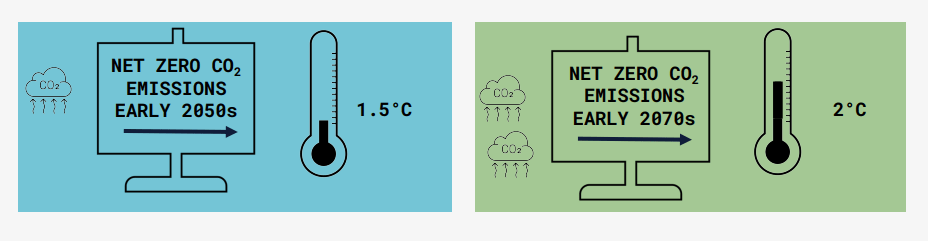
Current pledges to the Paris Agreement are insufficient and emissions must fall 43% by 2030 compared to 2019. Unless there are immediate and deep emissions reductions across all sectors, 1.5°C is beyond reach.
Increased evidence of climate action
There is an increased evidence of climate action. LDCs have emitted only 3.3% of global emissions in 2019, but carbon inequality still prevails with the average per capita emissions in 2019 being 1.7 tCO2e, as compared to the global average of 6.9 tCO2e.
There are options available now in every sector that can at least halve emissions by 2030
Energy
⎻ Major transitions are required to limit global warming ⎻ Reduction in fossil fuel use and use of carbon capture and storage ⎻ Low- or no-carbon energy systems ⎻ Widespread electrification and improved energy efficiency ⎻ Alternative fuels: e.g. hydrogen and sustainable biofuels
Demand and services
⎻ Potential to bring down global emissions by 40-70% by 2050 ⎻ Walking and cycling, electrified transport, reducing air travel, and adapting houses make large contributions ⎻ Lifestyle changes require systemic changes across all of society ⎻ Some people require additional housing, energy and resources for human wellbeing
Transport
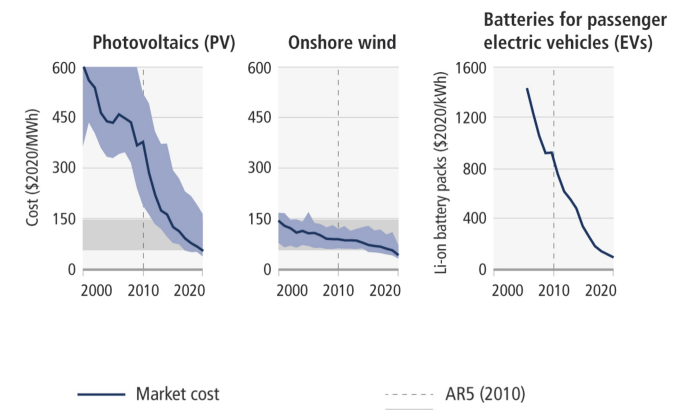
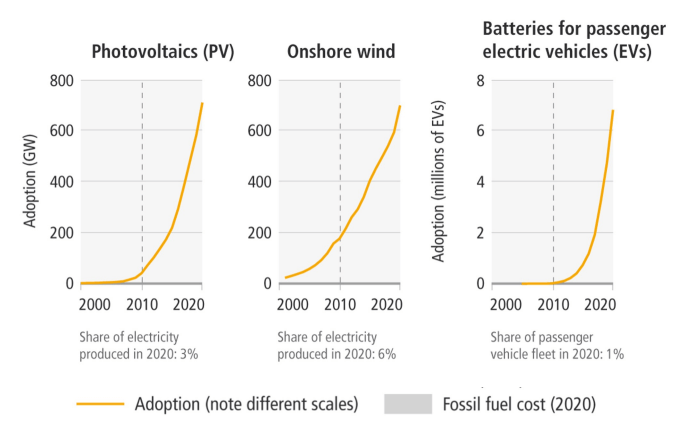
⎻ Reducing demand and low-carbon technologies are key to reducing emissions ⎻ Electric vehicles: greatest potential ⎻ Battery technology: advances could assist electric rail, trucks ⎻ Aviation and shipping: alternative fuels (low-emission hydrogen and biofuels) needed ⎻ Overall, substantial potential but depends on decarbonizing the power sector
Carbon Dioxide Removal
⎻ Required to counterbalance hard-to-eliminate emissions ⎻ Through biological methods: reforestation, and soil carbon sequestration ⎻ New technologies require more research, up-front investment, and proof of concept at larger scales ⎻ Essential to achieve net zero ⎻ Agreed methods for measuring, reporting and verification required
Policies, regulatory and economic instruments
⎻ Regulatory and economic instruments have already proven effective in reducing emissions ⎻ Policy packages and economy-wide packages are able to achieve systemic change ⎻ Ambitious and effective mitigation requires coordination across government and society
Technology and Innovation
⎻ Investment and policies push forward low emissions technological innovation ⎻ Effective decision making requires assessing potential benefits, barriers and risks ⎻ Some options are technically viable, rapidly becoming cost-effective, and have relatively high public support. Other options face barriers ⎻ Adoption of low-emission technologies is slower in most developing countries, particularly the least developed ones
The prospects for India’s real GDP growth for 2021-22 received a setback with the latest official projection (second advance estimate of NSO, MoSPI, GoI on 28 February 2022) dropping to 8.9 per cent (Figure 1) from 9.2 per cent (first advance estimate on 07 January 2022). However, the quantum of real GDP, has been estimated to increase from INR147.54 trillion (USD 1.95 trillion) (FAE) to INR 147.72 trillion (USD 1.95 trillion) (SAE). The growth of nominal GDP was revised upward from 17.6 per cent to 19.4 per cent, with the quantum of nominal GDP witnessing an uptick from INR 232.15 trillion (USD 3.06 trillion) to INR 236.44 trillion (USD 3.12 trillion) (SAE). The real GDP growth estimate for the previous fiscal year showed an improvement to -6.6 per cent (first revised estimate) from -7.3 per cent (provisional estimate).
Note: FRE: First Revised Estimate; SAE: Second Advance Estimate Source: Based on data accessed from MoSPI, GoI
India’s third quarter (Q3) real GDP fell sharply to 5.4 per cent from 8.5 per cent (Q2) and 20.3 per cent (Q1) (Figure 2).
Source: Based on data accessed from MoSPI, GoI
Projections of India’s real GDP growth for FY 22 and FY23 are presented in the following table. The lowest estimate for FY 22 is 8.7 per cent by the World Bank and the highest is 9.4 per cent by OECD. The highest projection for FY 23 at 8-8.5 percent has been estimated in the Economic Survey 2021-22 (MoF, GoI) and the lowest is by the World Bank at 6.8 per cent.
Source: (1) MoSPI, GoI, and Economic Survey 2021-22, MoF, GoI; (2) Monetary Policy Statement February 10, 2022, RBI; (3) Ecowrap, February 28, 2022, SBI; (4) World Economic Outlook, January 2022, IMF; (5) Global Economic Prospects, January 2022, World Bank; (6) India Economic Outlook, OECD, December 2021
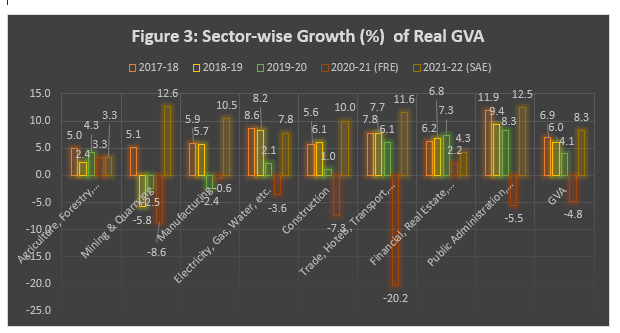
India’s real GVA is estimated to grow at 8.3 per cent (SAE) in FY22, downgraded from 8.6 per cent (FAE) (Figure 3). The sectors which witnessed high growth are mining and quarrying (12.6 per cent from a low base of -8.6 per cent in FY21), public administration (12.5 per cent from -5.5 per cent), manufacturing (10.5 per cent from -0.6 per cent), and trade, hotels, transport, etc. (11.6 per cent from -20.2 per cent). While the agriculture sector is estimated to grow at a constant rate of 3.3 per cent as in the previous year, financial, real estate and professional sector is estimated to grow at 4.3 per cent (from 2.2 per cent in FY 21) (Figure 3).
Source: Based on data accessed from MoSPI, GoI
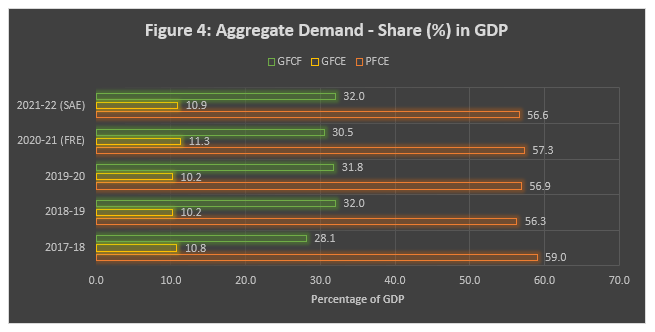
India’s growth has traditionally been consumption-led, and the share of private final consumption expenditure (PFCE) in GDP is estimated to decline to 56.6 per cent in FY22 (SAE) from 57.3 per cent in FY21 (Figure 4). The pandemic-induced loss of income and livelihood opportunities in the contact intensive service sector, the informal sector and rural areas, are expected to dampen India’s growth prospects for FY22. However, GoI’s thrust on investment in infrastructure, could lead to high and sustainable growth in income, employment and economic growth. While the estimated increase in the share of gross fixed capital formation (GFCF) from 30.5 per cent in FY21 to 32 per cent in FY22, is a stimulant for growth, the share of government final consumption expenditure (GFCE) which is estimated to decline from 11.3 per cent to 10.9 per cent, could drag down growth. However, the FY 23 Union Budget’s focus on investment in infrastructure with a significantly higher allocation over that of the previous Budget, would crowd in private investment and enable India to grow at around 8 per cent, while continuing to be the fastest growing large economy in the world.
Source: Based on data accessed from MoSPI, GoI
The economic impact of the third wave of the pandemic has not been as severe as that of the previous waves. The impact of global headwinds like the Russia-Ukraine conflict and the consequent sharp rise in the prices of crude oil and commodity prices, have not been factored in these estimates, and therefore, the final growth print could be 1-2 per cent lower. About 85 per cent of India’s demand for crude oil is met from imports and with the recent sharp rise in Brent crude price to USD 130/ barrel, there would be a sharp rise in the country’s import bill, worsening the country’s current account deficit. This would also lead to a sharper rise in retail inflation, which has already crossed RBI’s upper tolerance limit of 6 per cent. The RBI has continued with its accommodative stance with a view to revving up economic growth. However, with worsening inflationary expectations, the RBI could switch to a neutral stance, and could consider raising the repo rate by 25 bps in the next MPC meeting in April 2022 or in the June 2022 meeting. The developed economies are suffering from the worst phase of inflation in the last 3-4 decades, and the Central Banks in these countries have started tightening liquidity. The US Federal Reserve is expected to raise the Fed rate from the present near zero rate by 25 basis points, in March 2022, and at least two-three more rate hikes during the year.
The Russia-Ukraine conflict has also eroded financial markets globally, including India. Russian strikes at Europe’s largest nuclear plant in Ukraine wiped INR 5 trillion (USD 66 billion) off investor wealth in India on 04 March 2022, with the geopolitical tension eroding about INR 15 trillion ($197 billion) in fortune from 15 February 2022, when Russia announced a partial withdrawal of its troops from Ukrainian border only to launch a full-scale invasion later on.
Geopolitics could erode India’s growth prospects, depending on how long the Russia-Ukraine conflict and the consequent sanctions against Russia would continue. However, if the conflict ends within the next few months, and India gives a big push to investment in infrastructure, the country’s growth prospects could improve, and a 7.8 – 8 per cent growth in FY23 could be achievable.
IPCC’s Working Group – II (WG-II) has recently finalized their Assessment Report 2022 on the Impacts, Adaptation and Vulnerability relating to climate change and the global climate crisis on 27th February, 2022.
This report has pointed out stark findings on the impact of the current global warming of 1.1℃ on human and ecological systems. It also warns how the ability of humans to respond to the current global warming patterns will be increasingly limited with every additional increase in global warming temperatures. The report recognizes the interdependence of climate, biodiversity, humans and ecosystems (Figure 1).
The Union Budget 2022-23 is refreshingly growth oriented, futuristic and at the same time it aims to promote all-inclusive welfare. India’s economic growth which was already on a decelerating mode from 7.2% in 2017-18 to 6.1% in 2018-19 and further down to 4% in 2019-20, due to structural issues, and loss of momentum in economic reforms, fell sharply to -7.3% in 2020-21, as a result of the pandemic (Figure 1). However, the year 2021-22 is poised to reverse the trend to touch 9.2%, and India is set to regain its status as the fastest growing large economy.
Source: MoSPI, GoI
There are, however, looming headwinds like retail inflation breaching RBI’s upper tolerance limit of 6% (6.01% in January 2022) on account of rising food prices, international crude oil prices, with the Brent crude oil price hovering around $96 per barrel, and inching towards $100 per barrel, due to strong demand and supply disruptions as a result of the Ukraine crisis. The imminent speeding up of hikes in the Fed rate, and the consequent flight of capital from emerging market economies like India, could depreciate the Indian rupee further and could worsen the inflationary situation. Further, loss of lives and livelihoods, and consequently slow growth in consumption demand, along with weak growth in contact intensive sectors due to the pandemic, could prove to be a drag on the economy, if they persist for some more time.
Investment in Infrastructure for Turbo-charging the Indian Economy
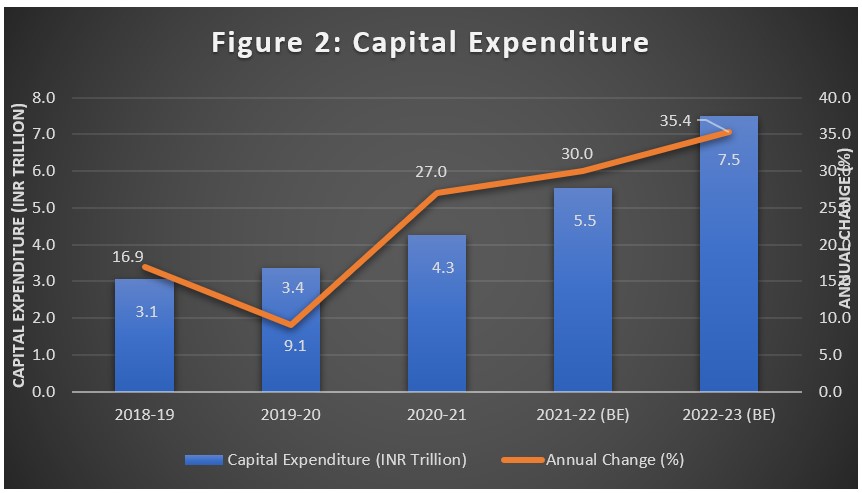
The Budget has done well to focus on the achievement of high, sustainable and inclusive growth. It has proposed a significantly higher allocation of 35.4% to capital expenditure to INR 7.5 trillion compared to INR 5.54 trillion in the previous year’s Budget, which is a continuance of strong growth in capital expenditure during 2020-21(actual) and 2021-22 (budget estimate) (Figure 2).
Source: Expenditure Profile (various issues), Ministry of Finance, Budget Division, GoI
The basic philosophy behind the Budget is to spend more in the core sector and accelerate growth. A massive release of funds for infrastructure projects will stimulate a large number of core sector suppliers such as steel and cement, which will create more jobs and increase economic demand and boosting growth in the economy. Investments in infrastructure is said to have a multiplier effect of four times of the money spent. As asserted by the Union Finance Minister Ms. Nirmala Sitharaman: “ Even if private investment is taking a while to come into this whole scene, the government will have to spend and pull the economy forward and gradually as we do this, we expect the private investment to come out in full force.”
The present Budget has carried forward the focus on investment in infrastructure for boosting economic growth, along with a focus on health and wellbeing of the people in the Union Budget 2021-22. The pillars on which the previous Budget rested were: health and wellbeing; physical and financial capital and infrastructure; inclusive development for an aspirational India; reinvigorating human capital; innovation and R&D; and minimum government and maximum governance. The Budget 2022-23 carries forward the pillars of the previous Budget, but adopts certain goals for the next quarter century – the Amrit Kaal – setting a blueprint for the vision of India@100, viz. complementing the macro-economic level growth focus with a micro-economic level all-inclusive welfare focus; promoting digital economy & fintech, technology enabled development, energy transition, and climate action; and relying on virtuous cycle starting from private investment with public capital investment helping to crowd-in private investment.
The four priorities for achieving the vision for India@100 articulated in the Budget are: PM Gati Shakti; Inclusive Development; Productivity Enhancement & Investment, Sunrise Opportunities, Energy Transition, and Climate Action; and Financing of Investments. PM Gati Shakti is driven by seven engines, viz. roads, railways, airports, ports, mass Transport, waterways, and logistics infrastructure. The aim is to bring about seamless multimodal movement of goods and people, which would lead to overall improvement of efficiency in the economy and ease of living. The PM Gati Shakti National Master Plan aims to bring about world class modern infrastructure and logistics synergy. This would lead to improvement in productivity and acceleration in economic growth and development on a sustainable basis.
Ecologically sustainable connectivity in hilly areas, through National Ropeways Development Programme, proposed to be taken up on PPP mode, would not only provide a convenient mode of transport, but would also promote tourism. The programme will also cover congested urban areas.
The Prime Minister’s Development Initiative for North- East (PM-DevINE), a new scheme for the development of the North Eastern States, with an initial allocation of INR15 billion, will fund infrastructure, in the spirit of PM Gati Shakti, and social development projects based on felt needs of the region The scheme will enable livelihood activities for youth and women,
The strengthening of health infrastructure, speedy implementation of the vaccination programme, and the nation-wide resilient response to the current wave of the pandemic, have been at the top of GoI’s agenda, for dealing with the present pandemic scenario, and making the country future ready to effectively address and manage pandemic situations.
Inclusive Growth and Welfare
Apart from the massive investment proposed for infrastructure, the Budget also prioritizes inclusive welfare and growth, while giving a short shrift to politically convenient sops and subsidies. Some of the prominent announcements for attaining inclusive growth are as follows:
Modernizing the agriculture sector
Delivery of digital and hi-tech services to farmers with involvement of public sector research and extension institutions along with private agri-tech players and stakeholders of agri-value chain, a scheme in PPP mode; promoting ‘Kisan Drones’ for crop assessment, digitization of land records, spraying of insecticides, and nutrients; promoting zero-budget and organic farming, modern-day agriculture, value addition and management; raising fund with blended capital, under the co-investment model, facilitated through NABARD, to finance startups for agriculture & rural enterprise, which will support FPOs, machinery for farmers on rental basis at farm level, and technology including IT-based support; implementing the Ken-Betwa Link Project, at an estimated cost of INR 446.05 billion, aimed at providing irrigation benefits to 0.91 million hectare of farmers’ lands, drinking water supply for 6.2 million people, 103 MW of Hydro, and 27 MW of solar power; support to concerned states for implementing the linking of five rivers, viz. Damanganga-Pinjal, Par-Tapi-Narmada, Godavari-Krishna, Krishna-Pennar and Pennar-Cauvery; a comprehensive package for promoting food processing with participation of state governments, which would facilitate farmers to adopt suitable varieties of fruits and vegetables, and to use appropriate production and harvesting techniques.
Revamping the MSME Sector
Interlinking Udyam, e-Shram, NCS and ASEEM portals, to provide services related to credit facilitation, skilling, and recruitment with an aim to further formalise the economy and enhance entrepreneurial opportunities for all; extending Emergency Credit Line Guarantee Scheme (ECLGS) up to March 2023 and expanding its guarantee cover by INR 500 billion to total cover of INR 5 trillion, with the additional amount being earmarked exclusively for the hospitality and related enterprises; revamping the Credit Guarantee Trust for Micro and Small Enterprises (CGTMSE) scheme to facilitate additional credit of INR 2 trillion for Micro and Small Enterprises and expand employment opportunities; and rolling out the Raising and Accelerating MSME Performance (RAMP) programme with outlay of INR 60 billion over 5 years to help the MSME sector become more resilient, competitive and efficient.
Creating a Strong Digital Ecosystem
Aligning the National Skill Qualification Framework (NSQF) with dynamic industry needs; launching Digital Ecosystem for Skilling and Livelihood – the DESH-Stack e-portal; promoting startups to facilitate ‘Drone Shakti’ through varied applications and for Drone-As-A-Service (DrAAS); Establishing Digital University to provide access to students across the country for world-class quality universal education with personalised learning experience at their doorsteps; rolling out an open platform, for the National Digital Health Ecosystem; and launching a ‘National Tele Mental Health Programme’ to improve the access to quality mental health counselling and care services.
Women Empowerment and Child Development
Mission Shakti, Mission Vatsalya, Saksham Anganwadi and Poshan 2.0 were launched recently to provide integrated benefits to women and children. The new generation The Budget has proposed to upgrade 0.2 million anganwadis to Saksham Anganwadis, with improved infrastructure.
Housing and Drinking Water for All
Universal coverage of low-cost housing and access of every household to tapped drinking water, aim at ease of living for all.Therefore, under the PM Awas Yojana, 8 million houses are expected to be completed during 2022-23. Currently, 87 million households have access to drinking water under Har Ghar, Nal Se Jal. The scheme aims to cover 38 million households in 2022-23.
Addressing Rural-Urban Divide
Aspirational Districts Programme
Under the Aspirational Districts Programme improvement in the quality of life of citizens in the most backward districts of the country has been observed, 95% of those 112 districts having made significant progress in key sectors such as health, nutrition, financial inclusion and basic infrastructure, surpassing the state average values. However, some blocks in those districts, continue to lag. Therefore, in 2022-23, the programme will focus on such blocks in those districts, under the Aspirational Blocks Programme.
Vibrant Villages Programme
A new Vibrant Villages Programme will be implemented in villages on the northern border, with sparse population, limited connectivity and infrastructure. The activities under the programme will include construction of village infrastructure, housing, tourist centres, road connectivity, provisioning of decentralized renewable energy, direct to home access for Doordarshan and educational channels, and support for livelihood generation. Existing schemes will be converged with this programme.
Digital Financial Inclusion
Post Offices under core banking system
100% of 1.5 lakh post offices will come on the core banking system enabling financial inclusion and access to accounts through net banking, mobile banking, ATMs, and also provide online transfer of funds between post office accounts and bank accounts.
Digital Banking Units
75 Digital Banking Units (DBUs) are proposed to be set up in 75 districts of the country by Scheduled Commercial Banks.
Financial support for digital payment
Financial support for digital payment ecosystem announced in the previous Budget will continue in 2022-23.
Productivity Enhancement
Major sectors of the Indian economy need to become globally competitive, if India is to grow rapidly and sustainably over the next quarter of a century to transform itself into a global economic powerhouse. Some of the major announcements in this regard are as under:
Ease of Doing Business 2.0 & Ease of Living
The next phase of EODB and Ease of Living would aim to improve productive efficiency of capital and human resources, with the government following the idea of ‘trust-based governance’. Active involvement of the states, digitization of manual processes and interventions, integration of the central and state-level systems through IT bridges, a single point access for all citizen-centric services, and a standardization and removal of overlapping compliances, are expected.
Energy Transition, Climate Action and Circular Economy
The Hon’ble Prime Minister of India, at the COP26 summit in Glasgow had said, “what is needed today is mindful and deliberate utilization, instead of mindless and destructive consumption.” The low carbon development strategy indicates the government’s strong commitment towards sustainable development. The Budget has announced the following short-term and long-term actions:
Additional allocation for PLI
An additional allocation of INR195 billion for PLI for manufacture of high efficiency modules, in order to facilitate domestic manufacturing for achieving the ambitious goal of 280 GW of installed solar capacity by 2030.
Transition to circular economy
The transition to circular economy is expected to help in productivity enhancement as well as creating large opportunities for new businesses and jobs. While the action plans for ten sectors such as electronic waste, end-of-life vehicles, used oil waste, and toxic & hazardous industrial waste are ready, the Budget identifies policy focus on addressing important cross cutting issues of infrastructure, reverse logistics, technology upgradation and integration with informal sector.
Transition to carbon neutral economy
While five to seven per cent biomass pellets will be co-fired in thermal power plants resulting in CO2 savings of 38 MMT annually, it will also provide extra income to farmers and create job opportunities, while helping avoid stubble burning in agriculture fields.
Urban Development
India @100 will have nearly half its population living in urban areas. The government plans to nurture the megacities and their hinterlands to become current centres of economic growth and also to facilitate tier 2 and 3 cities to take on the mantle in the future to realise the country’s economic potential, including livelihood opportunities for the demographic dividend. States would be involved as partners in the process of urban planning and development, with financial support from the Central Government. The government also plans to promote a shift to use of public transport in urban areas, which will be complemented by clean tech and governance solutions, special mobility zones with zero fossil-fuel policy, and EV vehicles.
Telecom Sector
The Budget highlights the importance of telecommunication in general, and 5G technology in particular, as an enabler of growth and creation of employment opportunities. Spectrum auctions will, therefore, be conducted in 2022 to facilitate rollout of 5G mobile services within 2022-23 by private telecom providers. Further, a scheme for design-led manufacturing will be launched to build a strong ecosystem for 5G as part of the PLI Scheme.
Export Promotion
India needs to develop into an export-led economy if it is to grow into a $40 trillion economy by India@100. The Budget has announced that the Special Economic Zones Act will be replaced with a new legislation that will enable the states to become partners in ‘Development of Enterprise and Service Hubs’. This will cover all large existing and new industrial enclaves to optimally utilize available infrastructure and enhance competitiveness of exports.
Development of Sunrise Sectors
The Budget underscores the immense potential of Artificial Intelligence, Geospatial Systems and Drones, Semiconductor and its eco-system, Space Economy, Genomics and Pharmaceuticals, Green Energy, and Clean Mobility Systems, in achieving sustainable development at scale, modernizing the country, and also in creating employment opportunities for the youth, while making Indian industry more efficient and competitive.
Mission $40 trillion by India@100
The Union Budget 2022-23 is futuristic and has presented a blueprint to transform India into a leading global economic power by the year 2047. India’s nominal GDP in 2021-22 is estimated at INR 232.1 trillion, which is just over $3.1trillion, well short of $5 trillion by 2024-25.
Can India become a $40 trillion economy by India@100?
While the target may seem humongous, the basic ingredients for achieving the vision have been presented in the Budget, with a focus on investment in infrastructure and other capital investments, raising overall productivity in major sectors of the economy, export promotion, development of sunrise sectors, modernizing the agriculture and food processing sectors, comprehensive development of the North Eastern Region and aspirational blocks, and climate action for sustainable and inclusive development.
We recently had a conversation with Rajen Parikh, a Techno-Commercial Management professional, Founder & CEO, Orion Software Services & Adviser, InsPIRE. Here’s what he told us about his practical observations on startups.
It is fair to say that the multi-pronged initiatives by both government messaging & those from the educational institutes as well, start-ups have indeed mushroomed to a point where it is difficult to see the grass bed anymore! It is certainly an exciting and high-risk sector to dip one’s feet into, but I personally believe the journey has its own life-changing lessons and while success might be the end objective, it is a statistically documented fact that the rate of failure remains astonishingly high as well. However, success or failure notwithstanding, the pace in this ecosystem has accelerated in recent months, and unlikely it will slow down anytime soon.
Having gained Mentoring experience via my own adventures based on bootstrapping, Founders Fund and passionately sticking to my objectives, the journey succeeded in teaching me enough to share and extend my experience in the Start-up Ecosystem to help budding enthusiastic entrepreneurs avoid falling into some chasms that can be all consuming and disrupt one’s journey in an almost irretrievable way.
In my current engagements as an empaneled Mentor with reputed universities, and mentoring 3 ‘live’ start-ups via Incubation Centers and 2 via private entities, I have gained some new insights into how mentees think or see their enterprises. I wish it were just a matter of perception, but it is more than that- it is evidently a lack of patience and process-based engagement that I see as a shortcoming, which, I spend a great deal of time explaining and helping them overcome that and focus on the real tasks ahead.
The birth of this self-destructive perception truly is the clutter in the Start-up landscape! This is my personal analysis and conclusion, and not based on any scientific studies or research, so those wishing to dismiss or ignore my views, may please do so. I now feel that the Mentoring task only got harder, and without those extra efforts that any Mentor has to put in by way of a larger emotional, story-telling based approach – all of which would consume more time, the journey for the mentees and their dream project could be short lived. There is an ownership on Mentors now to do more & either rebuild a higher degree of confidence in the start-up owners, or instil new confidence based on one’s experience in varied circumstances.
Another trait I have noticed is wanting to stretch that investment or capital (on whatever method it might have been infused or granted- internal or external) to the maximum. Whilst this is a good trait, money used wisely never hurt, but the break-point or marooned point is hit sometimes due to lack of prioritizing on spends with those funds in hand. Here again, serious attention & guidance is needed to be given, and like the earlier pain point, this also needs a lot of discussion and persuasion on part of the mentors to get that priority matrix right. I am in the midst of this at the moment with my lot!
As these are some early-stage Start-ups I am engaged with, I will restrict my views to this one last point which I have encountered in my on-ground dealings. Wanting to scale up without a firm base (or a solid plan for one) too early on and wanting VC/Angel or Institutional Funding to get there. Here again, the desire and enthusiasm are personally appreciated but the truth is harder. Also, as we go rural where many start-ups are mushrooming at almost the same pace as the urban explosion, there is a serious handicap on presentation or creation of pitch-decks for these start-ups/owners/initiators. If this is not addressed by Mentors – yes, an added task on one’s to-do list – the journey gets more uphill for rural sector based aspiring entrepreneurs. Also, perhaps, VCs and other potential funding bodies need to take a softer look at interests from within the rural belt so that this sector too can have its glorious day in the sun!
Note: The opinion & views expressed here are the personal opinions/experience/views of Mr Rajen Parikh and shared here based on his current Mentoring assignments. He can be reached at – rajen@orionsoftwareservices.com








 Institute for Pioneering Insightful Research Private Limited (InsPIRE)