Posted in economics

Marked shrinkage in India’s FY 25 fiscal deficit for April-August at Rs 4.35 lakh crore

Dr Manoranjan Sharma, Chief Economist, Informerics Ratings

India’s deficit and debt dynamics imperil the macro-economy. While “fiscal policy plays a much more expansive role (than monetary policy), as fiscal structural policies affect growth, competitiveness, and the distribution of income and wealth” (Vitor Gaspar), a high fiscal deficit raises the interest burden crowding out expenditures on productive sectors, increasing the borrowing cost, and financially crowding out private investments leading to an inflationary spiral, weakening the balance of payments. There are also issues of making the financial sector reform more protracted, severely damaging the ability of future generations to meet their needs, and downgrading by rating agencies raise the cost of foreign borrowing by the private sector.

The issue of the damaging consequences of a high fiscal deficit is not unique to India; it is commonplace in most countries of the world. This is why the Director of the IMF’s Fiscal Affairs Department Vitor Gaspar cogently argues in his incisive and insightful piece in Foreign Policy “Countries around the world face a fiscal policy trilemma: pressure to increase spending, public resistance to higher taxes, and risks from rising debt levels. Countries must navigate these challenges to maintain economic stability and growth.

There are elements of commonality and change with the world economy of the early 1980s. While global growth is wilting and the interest rate trajectory is indeterminate, climate change, demographic transition, and the fight against poverty and inequality exacerbate the situation.

In an enlightening piece published on September 16, 2024, based on a comprehensive analysis of 65 advanced and emerging market countries (EMEs) over six decades, Era Dabla-Norris, Enrico Di Gregorio, and Yongquan Cao of the IMF demonstrate that “large fiscal deficits and elevated debt levels call for greater fiscal prudence, but political forces are pulling in the opposite way.”

The Evolving Indian Scenario

In conformity with our expectations, India’s fiscal deficit for April to August 2024 came in at Rs. 4.35 lakh crore rupees. This deficit constituted 27% of the Budgetary estimates and marked a welcome reduction from the previous year’s level of 36%. Total receipt was Rs. 12.17 lakh crore rupees; overall expenditure was Rs. 16.52 lakh crore. They were 38% and 34.3%, respectively of FY 25 target.

This dataset assumes greater significance in the overarching context of the government’s avowed aim of steadily narrowing the fiscal deficit to 4.9% of GDP in FY 25 vis-à-vis 5.6% in FY 24 and the compelling evidence that the process of fiscal glide path and fiscal consolidation is on. This fiscal consolidation process was facilitated by the Reserve Bank of India’s Rs 2.1 lakh crore dividend —the highest-ever dividend to the Government of India for FY 2024. Going ahead, continued tax buoyancy and realization of non-tax revenues are integral elements of a prudent fiscal policy.

Divergent State Finances-One Size Doesn’t Fit All!

The issue of India’s fiscal deficit at the Centre cannot be considered in isolation, and the fiscal deficit at the States must also be considered for a comprehensive assessment and perspective in the quest for restoring financial stability. This is important because of the reversion to the old pension scheme (OPS) by some States, the burgeoning wage and pension bills, and the extensive recourse to freebies in the process throwing all norms of fiscal balance and prudence to the winds. This disconcerting financial distress is starkly reflected in the financial woes of States like Himachal Pradesh (HP) and Punjab.

For example, HP’s outstanding debt rose from Rs. 88,000 crore last year to almost Rs 97,000 crore this year. In percentage terms, HP’s fiscal deficit zoomed from 3.5 % of GSDP in 2019-20 to 6.5 % in 2022-23. It needs no clairvoyance to perceive that such unsustainably mounting debt creates a future liability (interest payments and repayment of the principal). If the money so raised is dissipated in revenue expenditure, debt servicing will surge crowding out productive expenditures and lead to a vicious cycle.

No wonder, then, that the State is broke with the State finding it excruciatingly difficult to pay even the salaries of its employees, red flags abound and the development expenditure has come to a grinding halt because of such fiscally unwise moves. It has to be realized the hard way that alluring politics makes bad Economics.

Similarly, Punjab is in a complete financial mess because of the double whammy of expenditure well over its fiscal space and a conspicuous absence of measures to promote internal resource generation. The crux of the issue boils down to expenditure control, efficient plan administration, and the generation of new and stable revenue streams. These elements must constitute effective planks of a judicious fiscal policy both at the Centre and the States. There has, however, to be a sharper focus on the fiscal vulnerabilities of States, where things seem to have gone beyond manageable proportions, to reduce deficits and debt down to sustainable levels and facilitate fiscal recovery. Difficult but doable with political will.

Posted in economics

RBI’s August 2023 Policy – On Expected Lines

Dr. Manoranjan Sharma, Chief Economist, Infomerics Ratings

This Policy is on expected lines. Low global growth is on because of geo-politics-high inflation, deteriorating financial conditions, Russia Ukraine war and growing economic fragmentation. The financial system is constrained by higher inflation, rising interest rates and stress in financial markets.

In view of global cues, improved crop sowing, uneven monsoon, good industrial growth, buoyant services activity, buoyant aggregate demand conditions, rising investment activity, and 2 % CAD, real GDP growth for 2023-24 is 6.5 %.

Higher food inflation in July occurred because of increase in prices of vegetables, particularly tomato prices and further increase in prices of cereals and pulses. 

Uncertainties also stem from El Niño conditions, global food prices and crude oil prices raising annual inflation projection to 5.4 %. But we are confident that retail inflation would be contained within the RBI’s upper threshold level of 6 %. 

Surplus liquidity rose to ₹ 1.7 lakh crore to ₹ 1.8 lakh crore because of return of ₹2000 banknotes, RBI’s surplus transfer to the government, pick up in government spending and capital inflows. Hence the RBI move to bring 10% ICRR for lenders to absorb surplus liquidity makes sense in view of the surplus liquidity in the system due to various factors, including the deposit of Rs 2,000 currency notes. As the Governor rightly pointed out “Even after the temporary ICRR, there will be adequate liquidity in the system to meet the credit needs of the economy”.

The proposed framework for the transparent reset of home loan rates and EMIs is also contextually significant and greatly welcome because of the inherent difficulties in resetting home loans.

With growth in bank credit, low NPAs and adequate capital and liquidity buffers, the Indian financial sector is stable and resilient. 

In view of the evolving macro-economy and the trade-off between growth and inflation, the RBI rightly kept the rates and stance unchanged. Right call!

Posted in economics

RBI Pauses Repo Rate Hike – Will it be One-off or a Long Pause?

Dr Debesh Roy, Chairman, InsPIRE

The Monetary Policy Committee (MPC) of the Reserve Bank of India (RBI) on 6 April 2023 unanimously decided to keep the policy repo rate unchanged at 6.5%, “with readiness to act, should the situation so warrant” as clarified by Mr. Shaktikanta Das, Governor, RBI. While major central banks across the world, viz., the US Federal Reserve, Bank of England, European Central Bank, etc., are continuing to tighten monetary policy, albeit at a reduced pace, RBI pressed the pause button.

The RBI has increased the policy repo rate cumulatively by 250 bps in the last 11 months starting May 2022, which was preceded by the introduction of the Standing Deposit Facility (SDF) at a rate 40 bps higher than the fixed rate reverse repo. Therefore, there has been a 290 bps effective rate hike since April 2022. These increases have been fully transmitted to the overnight weighted average call money rate (WACR), the operating target of monetary policy, which has gone up from daily average of 3.32% in March 2022 to 6.52% in March 2023. Hence, the RBI felt it was necessary to evaluate the cumulative impact of these rate hikes. Therefore, the RBI Governor asserted that “it’s pause, not a pivot.”

Further, the MPC in a 5:1 majority decided “to remain focused on withdrawal of accommodation to ensure that inflation progressively aligns with the target, while supporting growth”. The RBI Governor argued that “since the inflation rate was above the target and given its current level, the present policy rate could still be regarded accommodative”. In this context, the State Bank of India (SBI) research bulletin Ecowrap, has averred that “RBI has made a clear distinction between policy strategy and policy stance once again and asserted that these can coexist simultaneously. While it has kept the stance same as ‘withdrawal of accommodation’ to calibrate liquidity and ensure that government borrowings face no disruption, its strategy has been changed by hitting the pause button on rate hike”.

The  MPC decided to marginally reduce the consumer price index (CPI) inflation forecast for 2023-24 from 5.3% to 5.2%, assuming a lower annual average crude oil price at $85 per barrel, compared to $90 per barrel earlier, coupled with a normal monsoon. Within a week of the announcement of the monetary policy, the National Statistical Office (NSO)  announced the easing of retail inflation to a 15-month low of 5.66% in March 2023 from 6.44% in the previous month, due to continued moderation in food, fuel, housing and services prices. The retail inflation figure came within RBI’s upper tolerance limit of 6% for the first time in 2023. Importantly, core inflation (which excludes food and fuel inflation) dropped to 5.66% in March 2023 from 6.44% in February 2023, having remained sticky at 6% or above since September 2022. This could give the central bank breathing space for a longer  pause in rate hike. The trend in CPI inflation and core inflation vis-a-vis  repo rate is presented in the following chart.

The expected record rabi production, followed by good kharif production due to favourable monsoon – the first estimate of the India Meteorological Department (IMD), indicating normal monsoon at 96% of Long Period Average (LPA) (although the projection by Skymet indicates slightly below normal monsoon at 94% of LPA) – could lead to a lower inflation trajectory.

The real GDP growth for 2023-24 has been projected by RBI at 6.5 per cent with Q1:2023-24 at 7.8 per cent; Q2 at 6.2 per cent; Q3 at 6.1 per cent; and Q4 at 5.9 per cent, with risks evenly balanced. However, the IMF has cut India’s growth estimate for 2023-24 to 5.9% from 6.1%, citing lesser scope for pent-up demand due to historical revisions to data. The growth projections by Government of India’s Economic Survey, World Bank, ADB, S&P, OECD, ICRA and India Ratings for 2023-24 are 6.5% 6.3%, 6.4%, 6%, 5.9%, 6% and 5.9%, respectively. 

Headwinds like uneven monsoon or elevated crude oil prices at above $90 per barrel, due to the planned cut in production by the OPEC+ countries, could raise inflation, and result in one or two more rate hikes of 25bps each by the MPC during the current fiscal year, till another pause. However, if inflation continues to move southwards, due to record rabi production, normal monsoon,  favourable base effect, and international crude oil prices remaining within $85 per barrel, and also given the recent growth projections, we expect that there could be a long pause in repo rate by the RBI, instead of a one-off one. This could be followed by a rate-reduction cycle, starting as early as April  2024.  

Posted in economics

RBI Monetary Policy: Repo Rate Hike by 25 Bps, As Concerns for Core Inflation Remain

Dr Debesh Roy, Chairman, InsPIRE

The Reserve Bank of India (RBI) raised the policy repo rate by 25 basis points (bps) to 6.5% on 8th February 2023.  The Monetary Policy Committee (MPC) of the RBI in a 4:2 majority decision flagged the stickiness of core inflation as the reason behind the hike, although headline CPI inflation has been sliding below RBI’s upper tolerance limit of 6% since November 2022. Considering the slowdown in headline inflation, the hike in the repo rate has been reduced to 25 bps from 50 bps in October 2022 and 35 bps in December 2022. The observations of RBI Governor Shaktikanta Das that “we need to see a decisive moderation in inflation” could be an indication that the MPC is not done with the hike cycle yet. However, there could well be a pause in the repo rate in the next MPC meeting in April 2023, assuming further decline in retail inflation in January and February 2023.

The MPC has indicated a mixed outlook for inflation. It has stated that: “while prospects for the rabi crop have improved, especially for wheat and oilseeds, risks from adverse weather events remain.” The MPC also expects that commodity prices could face upward pressures with the easing of COVID-related mobility restrictions in some parts of the world. Further, the ongoing pass-through of input costs to output prices, especially in services, could continue to exert pressures on core inflation. The RBI’s enterprise surveys indicate some softening of input cost and output price pressures in manufacturing. In view of these factors and also assuming an average crude oil price (Indian basket) of US$ 95 per barrel, the MPC has projected inflation at 6.5% in 2022-23, with Q4 at 5.7%. Further, assuming a normal monsoon, CPI inflation is projected at 5.3% for 2023-24, with Q1 at 5.0 per cent, Q2 at 5.4%, Q3 at 5.4% and Q4 at 5.6%, and risks evenly balanced.

Further, MPC has projected real GDP growth for 2023-24 at 6.4% with Q1 at 7.8%, Q2 at 6.2%, Q3 at 6.0% and Q4 at 5.8%, and risks broadly balanced. This could be possible due to the following factors: (i) Stronger prospects for agricultural and allied activities which could boost rural demand; (ii)The rebound in contact-intensive sectors and discretionary spending is expected to support urban consumption; (iii) Businesses and consumers surveyed by the RBI are optimistic about the outlook; (iv) Strong credit growth, resilient financial markets, and the government’s continued thrust on capital spending and infrastructure would create a congenial environment for investment. However, on the flip side, there could be an adverse impact on exports, due to tepid external demand on account of a slowdown in global activity.

Posted in agriculture, economics

Attaining $100 Billion Agriculture and Food Exports

Dr Debesh Roy, Chairman, InsPIRE

India is among the top ten exporting countries of agriculture and food products in the world. The country’s agri-exports grew by a robust 20.4% in 2021-22, to touch a record $50.2 billion.  The importance of India in the international agri-market is continuously increasing and the country has developed export competitiveness in certain specialised products. There has been a rising demand for Indian Basmati rice, non-Basmati rice, spices, and sugar as evident by their rising share of the total agricultural export.

The country needs to significantly enhance agriculture and food exports, while ensuring that agricultural products are globally competitive. However, global headwinds due to the Russia-Ukraine conflict, disruption in global supply chain, unprecedented inflation, and monetary tightening by central banks of the developed countries, have adversely impacted global trade, and growth prospects across countries, including India.

Unstable agri-trade regime in India, reflected by knee-jerk reactions by the government to control prices in the domestic market, by banning exports of major agri-commodities, viz., rice, wheat, sugar, or onion, has been a major factor affecting agri-exports. Imposition of Minimum Export Price (MEP) is another tool often used by the government to tame inflation. Such moves bring relief to domestic consumers, but create uncertainty among importing countries, and deprive farmers of higher returns from their produce, which also discourages them to increase the area under cultivation of the crop in the subsequent season.

India’s Agriculture Export Policy (AEP), 2018, aims at promoting a stable trade regime, while setting an export target of $60 billion by 2022 and $100 billion within a few years, thereafter. Considering the strong agri-export growth during 2021-22, and the urgency of doubling farmers’ income, a target of $100 billion agri-exports from India could be set for 2026-27. However, this would be a daunting task, considering the present global economic situation.

In order to catch up with Brazil and China in agri-exports, India needs to bring about comprehensive structural reforms in the agriculture sector, with a focus on agriculture and food exports. The prerequisite for achieving the agriculture export target of $100 billion should be a well-calibrated, comprehensive, strategic, and result-oriented agri-export policy and action plan, along with overall reforms in the agriculture and allied sector. Agriculture export reforms, free trade agreements (FTAs)/ comprehensive economic partnership agreements (CEPAs) with major trading partners, agriculture marketing reforms, developing efficient agri-value chains, and building agriculture export infrastructure, are some of the major reform measures that could be expedited.

Primary products constitute about 75 per cent of APEDA products exported from India, in terms of value (USD). Therefore, the agriculture export strategy should prioritise the development of export-oriented value chains in respect of dairy products, processed marine products, processed fruits and vegetables, cereal preparations, and organic food. As India moves towards the exports of semi-processed, processed, and specialised food products, more value addition will happen in the country leading to more employment creation and the growth of the food processing sector.

The agriculture export strategy should include the integration of value-added agriculture produce with global value chains (GVC), by adopting the best agricultural practices involving productivity gains and cost competitiveness, while enhancing farmers’ income. Export-oriented production through the development of clusters, viz., “One District One Product (ODOP)”, and dedicated supply chains will help to enhance the global image of Indian products.  

In recent years, several Indian agricultural products have been facing rejection and export bans in the EU, a key export destination for India’s agricultural exports, due to sanitary and phytosanitary (SPS) and technical barriers to trade (TBT) measures. To counter rejection by a partner country in forums like the WTO’s SPS Committee or TBT Committee, there is a need for data collection and scientific evidence-based reports. Further, it is important to build the capacity of our small, marginal, and medium farmers and processors and educate them about the export market requirements. It is, therefore, eminently important to sensitise and educate farmer producer organisations (FPOs) and other stakeholders in the agri-export value chains, on ways to address SPS/TBT-related issues. If domestic standards are aligned to international standards, there is less likelihood of product rejections, and it is easier to earn a premium price for certified products such as organic food products.

A key concern for both India and the UK, with respect to the agro-foods sector would be the removal of non-tariff barriers (NTBs). For India, for example, removal of NTBs in the form of less stringent Sanitary and Phytosanitary Requirements with respect to limits of pesticide residues, while for the UK, removal of NTBs in the form of easier labelling and registration procedures, customs requirements, etc., would be beneficial. Therefore, the India-UK negotiations for CEPA need to take note of this issue.

Growing protectionism across major economies is a serious threat to raising exports. This would require intense diplomatic efforts with India’s trading partners to finalise trade deals. Efforts to upgrade Economic Cooperation and Trade Agreement (ECTA) to CEPA with Australia, and finalise CEPAs with the UK, the EU, the US and Canada, need to gather momentum.

The strategy for promotion of agri-exports should include investments in agri-export zones (AEZs), dairy export zones (DEZ), agro-processing clusters/zones, marketing infrastructure, cold chains, warehouses, roads, railways, and logistics along the export-oriented agri-value chains, connecting to ports and airports through public, private, and Public Private Partnership (PPP) modes.

Reducing food loss and waste is a solution to reduce food and nutrition insecurity and Greenhouse Gas (GHG) emissions, without impinging on activities related to core economic development. Therefore, GoI should formulate a comprehensive national policy on ‘Achieving SDG 12.3 Targets by Minimising Food Loss’, to focus not only on minimising food loss but also on leveraging the potential to increase agro-based exports, resulting in augmented farm level income.

It has been observed that there is a strong impact of export financing on agricultural exports. Availability and affordability of export credit through lesser-explored mechanisms such as factoring, commodity exchange-facilitated financing, and value chain financing, would be critical for the achievement of the ambitious target for agricultural exports.

Concerted and coordinated efforts by GoI, state governments, APEDA, MPEDA, FIEO, TPCI, NDDB, GCMMF, food and agro-processing industry, RBI, NABARD, EXIM Bank, banks, agri-tech start-ups, FPOs/FPCs, and other stakeholders in the agri-export sector, would address a whole range of issues pertaining to the promotion of agriculture and food exports.

Finally, comprehensive reforms in the agriculture sector could propel India into the top bracket of agricultural exporters in the world, while attaining $100 billion in exports of agriculture and food products by 2026-27.

________________________________

(The contents of this blog have been drawn from the book India’s Agriculture and Food Exports: Opportunities and Challenges, edited by Debesh Roy and Bijetri Roy and published by Bloomsbury India.)

Posted in economics

Addressing India’s Inflationary Woes

Dr. Debesh Roy, Chairman, InsPIRE

Introduction

The global economy is hamstrung with rising inflation and slowing growth. Inflation is now well-entrenched across the world, and is definitely not transitory in nature, as thought by US Fed Chair Mr. Jerome Powell and several economists, few months ago. The US consumer inflation surged ahead to touch a more than four decades high of 8.6% annual rate in May 2022, due to spiraling energy and food prices. Similarly, inflation in the UK touched a 40-year high of 9% in April, and is expected to touch 9.1% in May. Further six member states of the EU have inflation rates above 10%, and the average is 8.1%. Most developing countries have been suffering from the wrath of inflation and slowdown in economic growth. Inflation in developed as well as developing economies has been sparked by low interest rates and government stimulus to counter the Covid-19 pandemic’s impact, and disruption in global supply chains, followed by elevated energy and commodity prices due to the Russia-Ukraine crisis.

India has been witnessing rise in retail inflation above the Reserve Bank of India’s (RBI) mandated tolerance level of 6%, from January 2022. Wholesale inflation, however, started rising alarmingly from March 2021, onwards. The RBI and Government of India (GoI) have initiated monetary and fiscal measures, respectively, to curb inflation.

Easing of India’s Retail Inflation

India’s retail [Consumer Price Index (CPI)] inflation eased in May 2022 to 7.04% from an almost eight years high of 7.79% in April (Figure 1). However, it remained above RBI’s upper tolerance level of 6% for the fifth month in a row.  There was a broad-based deceleration in inflation, mainly on account of slower increases in food prices. Core inflation, too, moderated in May to 6.09% from 6.96% in the previous month.

The slowing down of inflation was mainly on account of deceleration in rural CPI inflation, which declined significantly from 8.38% in April 2022 to 7.01% in May (Figure 1), as a result of a decline in the combined weighted contribution of health, education and personal care and effects by 35 basis points (bps), and 40 bps decline in the weighted contribution of food and beverages. Urban inflation, however, declined marginally from 7.09% in April to 7.08% in May (Figure 1). Favourable base effect, too contributed to the decline in inflation. However, there are more upside risks to inflation, with international crude oil prices remaining stubbornly high.

Source: Data accessed from MoSPI, GoI

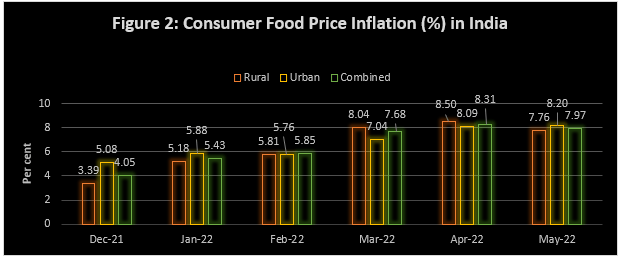
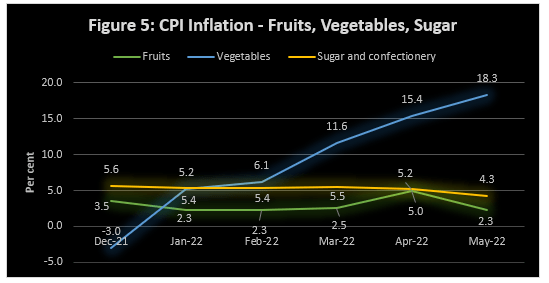
The consumer food price inflation (CFPI) is the major determinant of retail inflation in India, with a weightage of 39.1% in the CPI. During the six-month period December 2021 to May 2022, CFPI more than doubled from 4.05% in December to 8.31% in April, before dropping to 7.97% in May (Figure 2). This was due to elevated oils and fats inflation at 24.3% in December to 13.3% in May (Figure 3) and a sharp increase in vegetable inflation from -3% in December to 18.3% in May (Figure 5). India imports nearly 60% of its crude edible oil requirement. Around 90% of India’s annual crude sunflower oil requirement of 22-23 lakh tonne is imported from Ukraine to the tune of 70% and 20% from Russia and the remaining 10% from Argentina. The Ukraine-Russia conflict has disrupted supplies of sunflower oil and sharply pushed up its price in the international market, impacting India’s import cost.  

The principal reason for a sharp rise in vegetable prices is the increase in transportation cost due to high fuel price, which in turn is the result of elevated international price of crude oil. High tomato prices, due to fall in production on account of heatwaves prevailing in different parts of the country, also impacted vegetable inflation.

Source: Data accessed from MoSPI, GoI

While cereal inflation increased steadily from 2.6 % in December 2021 to 5,3% in May 2022, pulses inflation declined from 2.4% to -0.4% during the same period (Figure 3). Decline in pulses inflation was on account of record estimated production of pulses in the Kharif and Rabi seasons in the year 2021-22, as well as higher imports of Arhar and Urad.

Source: Data accessed from MoSPI, GoI

Inflation in eggs declined sharply from 4.2% in February to -4.6% in May (Figure 4). Meat and fish inflation rose to 8.2% in May from 7% in the previous month, before falling from 9.6% in March, while milk inflation increased steadily from 3.8% in December 2021 to 5.6% in May 2022 (Figure 4).

Source: Data accessed from MoSPI, GoI

Fruit inflation declined sharply from 5% in April to 2.3% in May, while sugar inflation fell from 5.2% to 4.3% (Figure 5).

Source: Data accessed from MoSPI, GoI

Fuel and light inflation remained elevated during the period at 11% in December 2021, 10.8% in April 2022 and 9.5% in May 2022 (Figure 6), on account of high international crude oil prices, with Brent crude prices remaining around $120 per barrel.

Source: Data accessed from MoSPI, GoI

Surging Wholesale Inflation

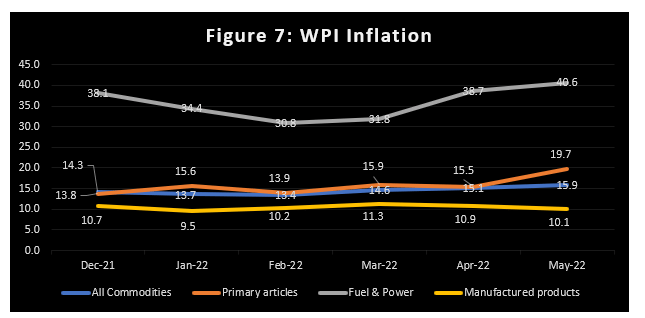
India’s wholesale price index (WPI) inflation increased from 15.1 in April to 15.9% in May, the highest level since August 1991, driven by soaring inflation of primary articles (15.5% to 19.7%) and fuel and power inflation (38.7% to 40.6%) (Figure 7). The wholesale inflation of manufactured products, however, eased from 10.9% to 10.1% (Figure 7).

Figure 8 shows that, the gap between wholesale and retail inflation narrowed down from 8.61% in December 2021 to 7.29% in April 2022, before rising to 8.84% in May. This was when retail inflation eased from 7.8% to 7% and wholesale inflation surged from 15.1% to 15.9%.

WPI inflation in the country has been increasing much faster than CPI inflation, since March 2021. Consequently, it is expected that retail inflation would slowly move closer towards wholesale inflation, in the months to come.  Dr. Pronab Sen, former Chief Statistician of India has put it succinctly: “Rising WPI will, by and large, translate into higher retail prices.” High wholesale inflation indicates that input price pressures are still quite high, which will eventually reflect on retail prices.

Source: Data accessed from Office of the Economic Adviser, DPIIT, Ministry of Commerce & Industry, GoI
Source: Data accessed from MoSPI, GoI and Office of the Economic Adviser, DPIIT, Ministry of Commerce & Industry, GoI

Addressing Inflationary Woes

The RBI raised the policy repo rate by 40 bps in May 2022 and 50 bps in June 2022. The central bank is no longer behind the curve and the transmission of the rate in the banking system is also expected to be reasonably quick. While increasing the repo rate could hurt India’s economic recovery, the inability to control inflation will hurt the country’s growth prospects in the medium to long term.

RBI’s inflation projection for FY23 is 6.7%. It is expected that RBI’s Monetary Policy Committee (MPC) could raise the policy repo rate by 60-85 bps by December 2023, i.e., to 5.5-5.75%, depending on the inflation trajectory. A further cause for concern is the depreciation of the rupee, which could worsen inflation. RBI Governor Mr. Shaktikanta Das, in his June 08, 2022 statement on the Monetary Policy has expressed RBI’s approach to control inflation as: “Our approach underscores a commitment to move towards normal monetary conditions in a calibrated manner. We will remain focused on bringing down inflation closer to the target and fostering macroeconomic stability.”

The full impact of the measures announced by the government, viz, excise duty cuts on petrol and diesel, could be seen in the June inflation figure, as the cut in excise duty was announced in the last week of May. With the end of Russia-Ukraine conflict nowhere in sight, inflationary situation could worsen across the world. Although there has been a steady rise in revenue collection so far in FY23, GoI may have to tread the tightrope of balancing excise duty cut for controlling fuel inflation with incurring the budgeted capital expenditure for economic growth.

Posted in economics

RBI’s June 2022 Monetary Policy : Driving Digitization

Dr. Manoranjan Sharma, Chief Economist, Infomerics Ratings, Delhi & Advisor, InsPIRE

The RBI’s June 2022 Monetary Policy has justifiably been in the news for the hike in the Repo rate by 50 bps to 4.90 per cent, the withdrawal of the accommodative stance, the raising of the RBI’s inflation projections for FY 23 by 100 bps to 6.7 per cent, the evolving growth-inflation dynamics and the risks of un-anchoring of inflation and inflationary expectations to macro-economic stability. While all these are valid concerns, the issue of the renewed thrust on digitization has not quite received the attention it rightly deserves. The limited purpose of this brief piece is to highlight the impetus provided in this Policy to the inexorable forces of digitization, which are now sweeping the banking and financial world.

Considered in a proper historical and comparative perspective, digitization and disruption have altered the rules of the game and brought about a new normal in this VUCA (volatility, uncertainty, complexity and ambiguity) world.

The issues of disruptive innovations and domain knowledge together with big-picture issues facing industries and organizations have become commonplace. These competitive realities have blurred industry boundaries, transformed standard practice and rendered conventional blueprint of development obsolete making it necessary to leverage the power of the digital by extrapolating the unknown.

In this evolving socio-economic order, there have been game changing changes in data analytics, digitalization and disruption because of the confluence of innovation, big data, artificial intelligence (AI), machine learning (ML), deep learning (DL), robotics, analytics, internet and entrepreneurship.

Progressive digitalization is reflected in Direct Benefit Transfers (DBTs), the JAM Trinity (Jan Dhan, Aadhaar, Mobile- RuPay Cards) and Unified Payment Interface, Digital India initiative and literacy programmes.

India is surging to a digital-first economy to meet the “revolution of rising expectations”. This implacable process has significantly influenced employee empowerment, customer engagement, operational efficiency and business models. All four dimensions of technology- revenue, expense, experience and accuracy or compliance- impacting a company-have improved remarkably. Aadhar has become a unifying platform with performance transcending ‘reach’ and ‘legacy’.

Digitization has transformed the entire financial sector because of reduced costs and unimaginably higher scale. Factors driving banking digitisation include digitally evolved consumers; smartphone penetration and low cost internet connectivity; cheaper products / services using M-banking and Wallet; government and RBI initiatives like Digital India, UPI, Bharat QR, Aadhaar, Point of Sale (PoS) and equipped market players.

The adoption and adaptation of new technology and digital payments have transformed conventional banking and significantly enhanced banking outreach. Progressively rising digitization has transformed lending processes, viz., credit assessment and loan approval, disbursement, repayment and customer services. But there is certainly a long road to traverse, as, for example, reflected in the fact that at end-March 2020, banks lent ₹ 1.1 lakh crore digitally vis-à-vis ₹ 53.1 lakh crore physically; NBFCs had ₹ 23, 000 crore digital loans as against ₹ 1.9 lakh crore loan physically. Enhanced mandates on recurring payments via credit and debit cards from ₹ 5,000 to ₹ 15,000 per transaction will drive digitization.

Electronic payments lead to convenience, discounts, tracking spends, lower risk and enhance gains. Linking of RuPay credit cards to UPI network could expand the credit market from the present level of 50 million to about 250 million users (at present UPI has 250 million users and 50 million merchants on-boarded), i.e., a massive five-fold rise.

With this game-changing development, the UPI’s coverage would transcend debit cards and bank accounts to credit cards. While pricing remains an issue, permitting UPI-based payments to credit cards could divert some expenditure from CASA accounts to credit cards. This would drive boost card utilisation level and enhance spends per card for banks with a higher share of RuPay cards.

UPI-based payment more than doubled to ₹ 84.16 lakh crore in 2021-22 from ₹ 41.04 lakh crore in FY21. The overall credit outstanding against credit cards stood at nearly ₹1.5 lakh crore as on April 22, 2022. With this strategic measure, both convenience and short-term liquidity will be greatly facilitated. As Victor Hugo (1802-1885) said in a different context, this is “an idea, whose time has come”.

Real time data on turnover, customer profile, lifestyle, spend, customers customer’s instantaneous data can transform Indian fintech’s rapidly expanding space. This is doable with convergence of data, technology and money to transform lives of borrowers, investors and businesses. But cyber security emerges as a key concern, particularly with data moving data offline to the cloud.

Revamped digital ecosystem and the winds of change sweeping India provide an enabling environment to revolutionise India’s socio-economic landscape, similar in its range and sweep perhaps only to the mobile or the internet revolution. This onward march would thus positively influence both growth and distributive equity.

Posted in economics, MARKET ECONOMY

RBI Intensifies its Attack on Spiraling Inflation

Dr Debesh Roy, Chairman, InsPIRE

The Monetary Policy Committee (MPC) of the Reserve Bank of India (RBI) on 8th June 2022, unanimously decided to raise the policy repo rate by 50 basis points (bps), the steepest increase in more than nine years, to 4.9 per cent. This is the second hike in the repo rate in just over a month, adding up 90 bps from 4 per cent set in May 2020, with a view to controlling inflation, aggressively. While the RBI was behind the curve to control inflation till the April MPC meeting, it took a decisive step to control spiraling inflation by raising the first repo rate hike in two years by 40 bps in the off-cycle MPC meeting  on 4th May 2022.

The MPC has increased the inflation forecast by 100 bps to 6.7 per cent for fiscal year (FY) 2022-23, and has projected an inflation rate of 7.5 per cent, 7.4 per cent, and 6.2 per cent for Q1, Q2 and Q3 of FY23, respectively. For the first time since the flexible inflation-targeting framework was introduced in October 2016, for policy repo rate setting by the MPC, the RBI, in all likelihood, will fail to achieve its mandate – which is to keep the average inflation at 4 per cent with a +/- 2 per cent tolerance limit – for three consecutive quarters. As per the mandate, RBI would need to explain to Government of India the reasons for inflation exceeding the upper tolerance limit of 6 per cent for three consecutive quarters.

Inflation is now a global phenomenon, due to the Ukraine-Russia war, Covid-related lockdowns in China and global supply chain disruptions. As stated by RBI Governor Mr. Shaktikanta Das, “The war has led to globalisation of inflation. Not surprisingly, central banks are reorienting and recalibrating their monetary policies. Emerging market economies (EMEs) are facing bigger challenges from increased market turbulence, monetary policy shifts in advanced economies (AEs) and their spillovers. The process of economic recovery in EMEs is also getting affected”.

The MPC also decided to drop the accommodative stance to “remain focused on withdrawal of accommodation to ensure that inflation remains within the target going forward, while supporting growth”. As RBI has embarked on an aggressive policy tightening cycle,  the MPC is expected to resort to calibrated tightening and could  decide on two more hikes of 25 bps each in FY23, taking the repo rate to 5.65 per cent by March 2023.

However, there could arise a risk of a wide divergence from RBI’s inflation projections, which could result in a sharper rate hike. Research by SBI shows that RBI could factor in a rate hike in August and even October MPC meetings, and take the repo rate higher than pre-pandemic level by August to 5.25 per cent and in October to 5.5 per cent. The peak rate at the end of the cycle, according to the SBI report now has a lower bound of 5.5 per cent and could go up to 5.75 per cent, depending on inflation trajectory.

Banks have raised their lending rates in response to the rise in the repo rate. This will cause borrowers to pay higher equated monthly instalments for their loans. Further, the demand for loans by retail as well as corporate borrowers would fall, restricting economic activities.

The RBI, however, has kept its growth forecast unchanged at 7.2 per cent for FY23,  with Q1, Q2 and Q3 growth at 16.2 per cent, 6.2 per cent,  4.1 per cent; and 4.0 per cent, respectively, with risks broadly balanced. According to the MPC statement, the recovery in domestic economic activity is gathering strength due to the following factors:

  • Rural consumption should benefit from the likely normal south-west monsoon and the expected improvement in agricultural prospects;
  • A rebound in contact-intensive services is likely to bolster urban consumption, going forward;
  • Investment activity is expected to be supported by improving capacity utilisation, the government’s capex push, and strengthening bank credit;
  • Growth of merchandise and services exports is set to sustain the recent buoyancy.

However, the MPC has warned that spillovers from prolonged geopolitical tensions, elevated commodity prices, continued supply bottlenecks and tightening global financial conditions nevertheless weigh on the growth outlook.

Posted in economics

RBI hikes Policy Repo Rate and CRR to address Rising Inflation

Dr Debesh Roy, Chairman, InsPIRE

In the face of an unabated rise in inflation, the Monetary Policy Committee (MPC) of the Reserve Bank of India (RBI), in an off-cycle meeting held on 2nd and 4th May 2022,  decided to raise the policy repo rate by 40 basis points (bps) to 4.4 per cent, and the cash reserve ratio (CRR)  by 50 bps to 4.5 per cent. This is the first hike in repo rate after almost two years.

The timing of the hike came as a surprise to the financial markets, with the Sensex crashing by 1,307 points, or 2.29 per cent lower than the previous day’s close (3rd May 2022). However, it was expected by economists that the MPC would start raising the policy repo rate anytime soon during FY23, as CPI inflation remained above RBI’s tolerance level of 6 per cent during the three months January-March 2022. Inflation in March 2022 was much above the tolerance limit at 6.95 per cent. The inflation outlook remained grim in the context of rising food prices, apart from the rise in global prices of crude oil, wheat and sunflower oil due to global supply disruptions on account of the Russia-Ukraine conflict.  

Further, the decision by Indonesia to ban exports of palm oil, due to fall in domestic production on account of labour shortage in the country, has resulted in a sharp rise in price of edible oils in India, which depends on imports from Indonesia for 60 per cent of its demand for palm oil.

The MPC in its previous meeting during 06-08 April 2022 had decided to remain accommodative while focusing on withdrawal of accommodation to ensure that inflation remains within the target going forward, while supporting growth. In its off-cycle meeting, the MPC using an almost similar language, continued to maintain an accommodative stance, while focusing on withdrawal of accommodation to ensure that inflation remains within the target going forward, while supporting growth.

The MPC has stated that inflation would “rule at elevated levels, warranting resolute and calibrated steps to anchor inflation expectations and contain second round effects”. Given RBI’s projection of 5.7 per cent inflation during FY23, which could well be revised upwards, it can be expected that the RBI would increase the policy repo rate going forward by 75 bps to touch the pre-pandemic level of 5.15 per cent by end March 2023. Further, the CRR hike by 50 bps will result in an upward pressure on interest rates while withdrawing system liquidity by an additional INR 87,000 crore.

While loans to retail and micro, small and medium enterprises (MSME) borrowers, linked to the policy repo rate will become costlier with immediate effect, interest rates on corporate loans will rise within a month or so. Following the decision of the RBI to raise the policy repo rate, Bank of Baroda and ICICI Bank raised their external benchmark-linked lending rates by 40 bps each.

While costlier loans to productive sectors would have an adverse impact on India’s growth prospects, the country can still maintain its position as the fastest growing large economy in the world, with the government having prioritized investment in infrastructure, while also carrying forward its agenda of structural reforms, in addition to a focus on export-oriented manufacturing through the production linked incentive (PLI) scheme, and investment in education and health.

Posted in economics

Wholesale inflation surges to 4-month high in March 2022

Dr Debesh Roy, Chairman, InsPIRE

India’s Wholesale Price Index (WPI) inflation surged to a 4-month high of 14.55 per cent in March 2022, which was a sharp rise from 13.11 per cent in the previous month. This was the result of an unfavourable base effect (1.3 per cent in March 2021) and broad-based rally in global commodity prices, especially crude oil, due to the Russia-Ukraine conflict. With this, WPI remained in double digits throughout FY22. The average inflation at 12.94 per cent in FY22 is the highest in three decades.

While wholesale food inflation rate eased sequentially from 8.19 per cent to 8.06 per cent in March 2022, vegetable inflation dropped sharply from 26.93 per cent in the previous month, but remained elevated at 19.88 per cent. Among non-food items, crude oil inflation increased by a whopping 83.56 per cent, leading to a fuel inflation of 34.52 per cent during March 2022. Manufactured price inflation rate rose to 10.71 per cent during the month, from 9.84 per cent in the previous month, as edible oil and basic metals inflation rose to 16.06 per cent and 25.97 per cent, respectively. Core inflation, which excludes volatile food and fuel items, increased from 10 per cent in February 2022 to 10.9 per cent in March 2022.

Although WPI is not the primary index which guides the Reserve Bank of India’s (RBI) monetary policy decisions, it cannot be ignored by the central bank, as rising input costs can feed CPI inflation. This is likely to happen with businesses passing on the rising input costs to retail prices. The gap between WPI and CPI has narrowed from 9.96 percentage points in November 2021 to 7.60 percentage points in March 2022. CPI inflation is on a rising trend since November 2021 and has shot up to a 17-month high of 6.95 per cent in March 2022. What is worrisome is that retail inflation has remained above RBI’s tolerance level of 6 per cent for the third consecutive month.

RBI’s latest industrial outlook survey indicates that manufacturing sector firms expect higher input and output price pressures going forward. Further, on the assumption of a normal monsoon in 2022 and average crude oil price (Indian basket) of US$ 100 per barrel, RBI, in its latest monetary policy (8 April 2022) has projected 5.7 per cent inflation in 2022-23. While the Monetary Policy Committee (MPC) has unanimously decided to maintain the accommodative policy stance, it will focus on withdrawal of accommodation to ensure that inflation remains within the target going forward, while supporting growth. Globally inflation is on the rise, and will continue to remain elevated even after the Russia-Ukraine conflict comes to an end. The uncertainty surrounding the conflict makes it difficult to estimate inflation during the next one-year period. This is true for most countries, including India. Going forward, RBI could raise the policy repo rate by 50 basis points (bps) during FY23.