Posted in economics

The Maharajah’s Homecoming: Tatas win Bid for Air India

Bijetri Roy, Managing Director & Chief Strategy Officer, InsPIRE

Government of India (GoI), by announcing the Tata Group as the winning bidder for the sale of Air India on 8th October 2021, paved the way for the “Maharajah” to go back to the Tatas after seven decades.  The bid was submitted by Tata Sons Pvt. Ltd. through its wholly owned subsidiary Talace Pvt. Ltd. At an enterprise value of INR 180 billion (USD 2.39 billion), the Tatas will get Air India, along with its low cost subsidiary Air India Express and a 50% stake in ground handling firm AISATS.

The Tatas will also get ownership of iconic brands like Air India, Indian Airlines, and the Maharajah, besides 141 aircraft and over 7,000 domestic and international airport slots. With the takeover of Air India, Tata Sons, which operates Vistara and AirAsia India, will become the second-largest airline in the domestic market with a market share of about 25%, and the largest Indian airline on international routes.

The bid value of INR 180 billion (USD 2.39 billion), includes INR 27 billion (USD 0.36 billion) to be paid by Tatas in cash for the acquisition, and INR 153 billion (USD 2.04 billion) debt that Tatas will take (to be retained in Air India). Further, Tatas will have to pay around INR 91.85 billion (USD 1.22 billion) towards capitalised lease obligation of 42 leased aircraft primarily the Boeing 787 Dreamliner aircraft.

This deal signifies the firm resolve of GoI to work towards strategic disinvestment, beginning with Air India, and to be followed by BPCL, Shipping Corporation of India, Container Corporation of India, IDBI Bank, BEML, Pawan Hans, Neelachal Ispat Nigam Limited, among others, to be completed in 2021-22, as announced in the Union Budget 2021-22.  Privatisation of Air India has been a complex issue and it took two decades to fructify, while GoI has been suffering a daily loss of INR 200 million (USD 2.66 million) and an annual loss of INR 73 billion (USD 0.97 billion) for running Air India. The impact on GoI’s finances after the sale would be INR 446.78 billion (USD 5.95 billion).

The sale of Air India to the Tatas promises to transform the Indian aviation sector, strengthening competition in the domestic market and making Air India a major player in the international aviation market. At the same time, it places India on the right track on disinvestments and economic reforms agenda of the government.

Posted in economics

Monetary Policy: RBI Retains Accommodative Stance, but Signals Beginning of Normalisation

Dr Debesh Roy, Chairman, InsPIRE

The Reserve Bank of India (RBI) retained its accommodative stance and kept policy rates unchanged in its latest monetary policy announced on 8 October 2021. However, the beginning of normalisation of policy stance by halting its bond-buying efforts, was evident.

The six-member Monetary Policy Committee (MPC), headed by Governor Shaktikanta Das, unanimously decided to retain the policy repo rate at 4% and the reverse repo rate 3.35%. However, all members, except one, voted to continue with the accommodative stance as long as necessary to revive and sustain growth on a durable basis and mitigate the impact of Covid-19 on the economy, while ensuring that inflation remains within the target going forward. The Governor made it clear: “We do realise that as we approach the shore; when the shore is so close, we don’t want to rock the boat because we realise there is a life, there is a journey beyond the shore”. 

However, the RBI decided to suspend the Government Securities Acquisition Programme (G-SAP), the Indian version of Quantitative Easing (QE) of the US. Through the G-SAP, RBI has  injected INR 2.2 trillion (USD 29.3 billion) of liquidity in the system [out of the total INR 2.37 trillion (USD 31.5 billion) injected through bonds], during the first six months of 2021-22. The central bank would absorb a higher quantum of liquidity gradually through its 14-day variable rate reverse repo (VRRR) auctions, from the current INR 4 trillion (USD 53.2 billion) to INR 6 trillion (USD 79.9 billion) in stages, by December 2021.

The Governor justified the suspension of G-SAP by stating: “Given the existing liquidity overhang, the absence of a need for additional borrowing for GST compensation and the expected expansion of liquidity in the system as Government spending increases in line with budget estimates, the need for undertaking further G-SAP operations at this juncture does not arise. The Reserve Bank, however, would remain in readiness to undertake G-SAP as and when warranted by liquidity conditions and also continue to flexibly conduct other liquidity management operations including Operation Twist (OT) and regular open market operations (OMOs)”.

Deputy Governor Michael D. Patra explained that RBI is still in passive liquidity mode and was accepting what the market was offering, and that the central bank aims to move to an active mode of liquidity management.

The RBI sharply moderated the outlook for CPI inflation during 2021-22 from 5.7% projected in the previous MPC meeting (04-06 August 2021) to 5.3%, due to easing of food prices, combined with favourable base effects. However, prices of crude oil which will remain volatile over uncertainties on the global supply and demand conditions, rising metals and energy prices, acute shortage of key industrial components and high logistics costs are adding to input cost pressures. The inflation projection for Q2 FY2021-22 was reduced from 5.9% to 5.1%; and 5.3% to 4.5% in Q3. The inflation projection, however, remained the same at 5.8% for Q4. The risks continued to remain broadly balanced. The inflation projection for Q1 2022-23 was raised from 5.1% to 5.2%.

Projection for India’s GDP growth rate by the MPC was at 9.5%, which was same as the previous projection. Domestic economic activity is expanding with the weakening of the second covid wave. With favourable prospects for kharif and rabi crops, rural demand is expected to be buoyant. Significant increase in the pace of vaccination and the forthcoming festival season, are expected to support a rebound in the pent-up demand for contact intensive services, and boost growth. Easy monetary and financial conditions would also support growth. Further,  the reforms undertaken by the government focusing on infrastructure development, asset monetisation, taxation, telecom sector and banking sector should push up investor confidence, enhance capacity expansion and facilitate crowding in of private investment. The production-linked incentive (PLI) scheme also augurs well for domestic manufacturing and exports.

However, downside risks to growth are global semiconductor shortages, elevated commodity prices and input costs, and potential global financial market volatility. Projection for Q2 GDP growth was raised from 7.3% in the previous MPC meeting to 7.9%. Q3 projection was retained at  6.3%, and 6.1% growth was retained for Q4. The real GDP growth for Q1 2022-23 was estimated at 17.2%, which is same as the previous projection.

Given the inflation expectations and growth projections for the current financial year, it is expected that the RBI would retain its accommodative stance at least till the MPC meeting in April 2022, while maintaining the policy repo rate at 4%. However, the next step for the central bank in liquidity management would be to raise the reverse repo rate from 3.35% to 3.50% in December 2021 and 3.75% in February 2022.

Posted in economics

Strong Global Recovery on the Cards: India Set to Regain its Numero Uno Position

Bijetri Roy, Managing Director & Chief Strategy Officer, InsPIRE

The OECD, in its interim report for September 2021, has projected a strong, but uneven global growth in the years 2021 and 2022 (Charts 1 and 2). Government and central bank support and progress in vaccination would lead to growth above the pre-pandemic level. With countries emerging from the crisis facing different challenges, the growth would remain uneven.

Wide differences in vaccination rates between countries and emergence of new variants of the virus have restricted the opening up of economies and affected the supply chains. Output and employment gaps continue in many countries, especially in emerging-market and developing economies (EMDEs), where vaccination rates are low.

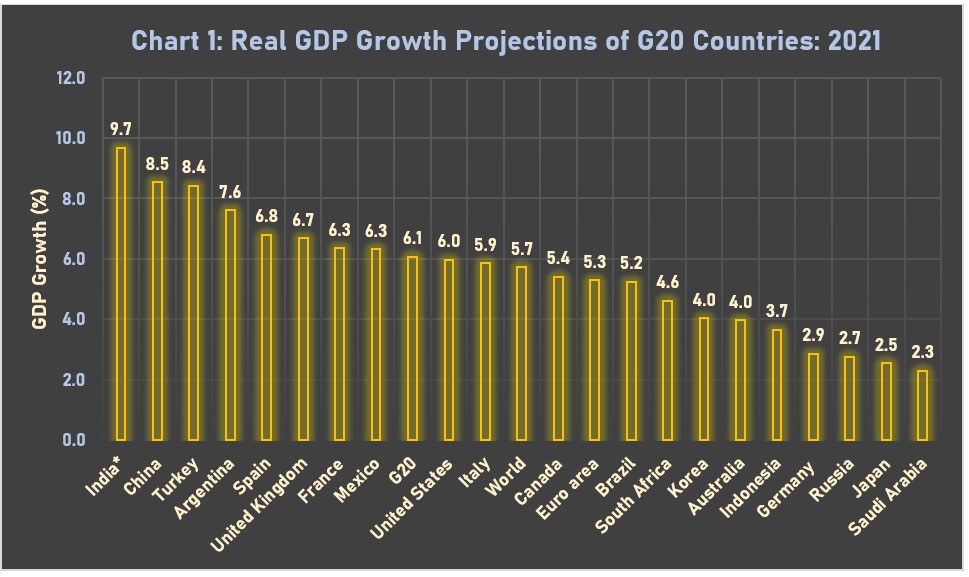
Estimates by OECD indicate that global GDP would grow at  5.7% in 2021 (Chart 1), followed by 4.5% in 2022 (Chart 2). The GDP has now surpassed its pre-pandemic level, but output in mid-2021 was still 3.5% below the projection made before the pandemic. This indicates  a real income shortfall of over $ 4.5 trillion (in 2015 PPPs). It is, therefore, imperative to close this gap to minimise long-term damage to the global economy from the pandemic through job and income losses.

G20 countries are expected to grow at 6.1% in 2021 (Chart 1) and 4.1% in 2022 (Chart 2), mainly driven by high growth in India (9.7%), China (8.5%), Turkey (8.4%), and Argentina (7.6%) in 2021. The year 2022 could witness a slower, although a stable growth due to pick up in investments and consumption, without the benefit of base effect. Growth in GDP in 2022 is expected to be influenced by India (7.9%), Spain (6.6%) and China (5.8%).

As indicated by high-frequency activity indicators, such as the Google location-based measures of retail and recreation mobility, global activity continued to strengthen in recent months, helped by improvements in Europe and a strong rebound in India and Latin American countries.  

India is set to regain its position as the fastest growing economy in the world.  According to OECD, India is expected to grow at a real GDP of 9.7% in 2021-22 (Chart 1), albeit from a low base. However, the Indian economy is expected to get on track to a long-term high growth trajectory, with a brisk growth of 7.9% in 2022-23 (Chart 2).

The Q1 (April-June 2021) GDP figures, the latest core sector growth data and recent positive high frequency activity data, indicate that the economy is gaining traction. Standard & Poor’s has also highlighted in a recent Asia Pacific report that India’s growth in GDP would  make a strong rebound in the July-September 2021 quarter, but warned against the impact of faster than expected tapering by the US Federal Reserve, causing capital flow risks as monetary policy by Reserve Bank of India (RBI) remains accommodative with real rate of interest in negative territory.

However, tapering by US Federal Reserve is expected to be gradual and EMDEs like India may not face an adverse situation similar to the taper tantrum of 2013. Moreover, India’s economic fundamentals are getting stronger, and the country could grow at a faster and more sustainable rate.

The Chinese economy is showing signs of a slowdown in economic growth. Troubles are brewing in the real estate and energy sectors in China. The country is facing an energy crunch due to shortages of coal for power generation, forcing it to increase purchase of natural gas. China’s power demand increased by 15% during the current year, but its domestic supply of coal – the largest source of power generation in the country – grew by just 5%. The Evergrande crisis has shown the fragility of the real estate sector in the country. If that is not all, the Chinese government’s recent crackdown on large corporations could impact investment and growth adversely.

*India’s data is for the  fiscal year 2021-22 
Source: OECD Economic Outlook, Interim Report September 2021
*India’s data is for the fiscal year 2022-23 
Source: OECD Economic Outlook, Interim Report September 2021.

The global economy continues to be in a state of flux. There is ample evidence to suggest that the supply shock reverberating around the world, combined with outbreaks of the Delta variant of corona virus, is tempering the recovery in growth. Results of business surveys from the US, UK and Eurozone suggest that economic activities have slowed down as delivery times grew longer and backlogs built up.

Policy Measures to Support Global Growth Prescribed by OECD

Governments need to ensure deployment of all resources necessary to accelerate vaccinations throughout the world to save lives, preserve incomes and control the virus. Also, there is need for stronger international efforts to support vaccinations in low-income countries.

Continuance of macroeconomic policy support, with the mix of policies contingent on economic developments in each country.

Maintenance of accommodative monetary policy, with a clear guidance about the horizon and extent to which any inflation overshooting will be tolerated.  Also, there needs to be a clear  roadmap towards normalisation of monetary policy.

Fiscal policies should remain flexible and contingent on the state of the economy.

Credible fiscal frameworks that provide clear guidance about the medium-term path towards debt sustainability, and likely policy changes along that path, to help maintain confidence and enhance the transparency of budgetary choices.

There is a need for stronger public investment and enhanced structural reforms for boosting resilience, and improving the prospects for sustainable and equitable growth.

Posted in economics

Brisk Core Sector Output Growth in August 2021

Dr Debesh Roy, Chairman, InsPIRE

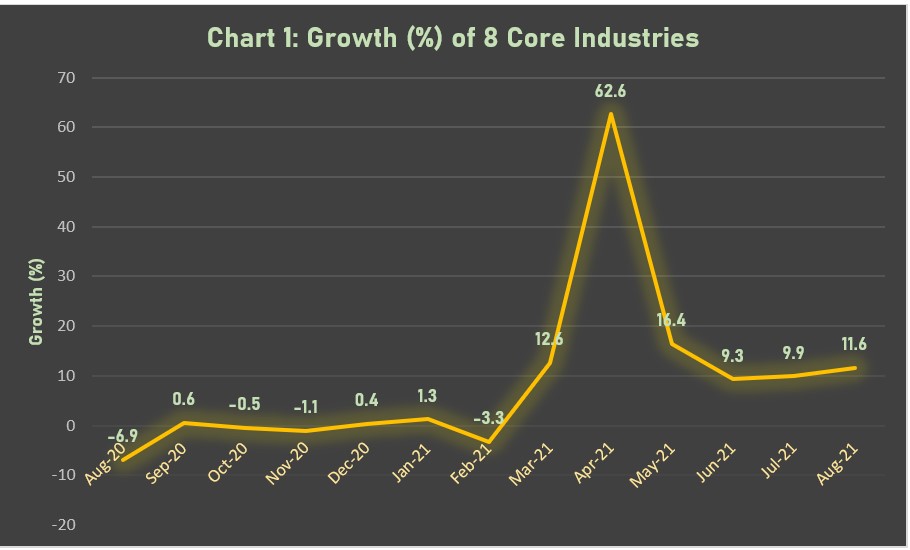
India’s eight core industries witnessed a brisk 11.6% growth in output in August 2021, compared with 9.9% in the previous month, and 9.3% in June 2021 (Chart 1), in spite of a less beneficial base effect. The sector also witnessed a 3.9% increase from the pre-Covid level of August 2019. However, the overall output was still lower by 0.3 per cent when compared to the February 2020 level.

During the period August 2020 to February 2021, the growth remained negative or very low, ranging between (-) 6.9% (August 2020) and 1.3% (January 2021), due to fall in consumption and investment demand on account of the impact of country-wide lockdown and slow opening up of the economic sectors. The growth rose sharply to 12.6% in March 2021 and  62.6% in April 2021, mainly due to low base effect.  The growth moderated to 16.4% in May 2021 (Chart 1).

Source of data: Press Release dated September 30, 2021, Office of the Economic Adviser, Department of Promotion of Industry & Internal Trade, GoI

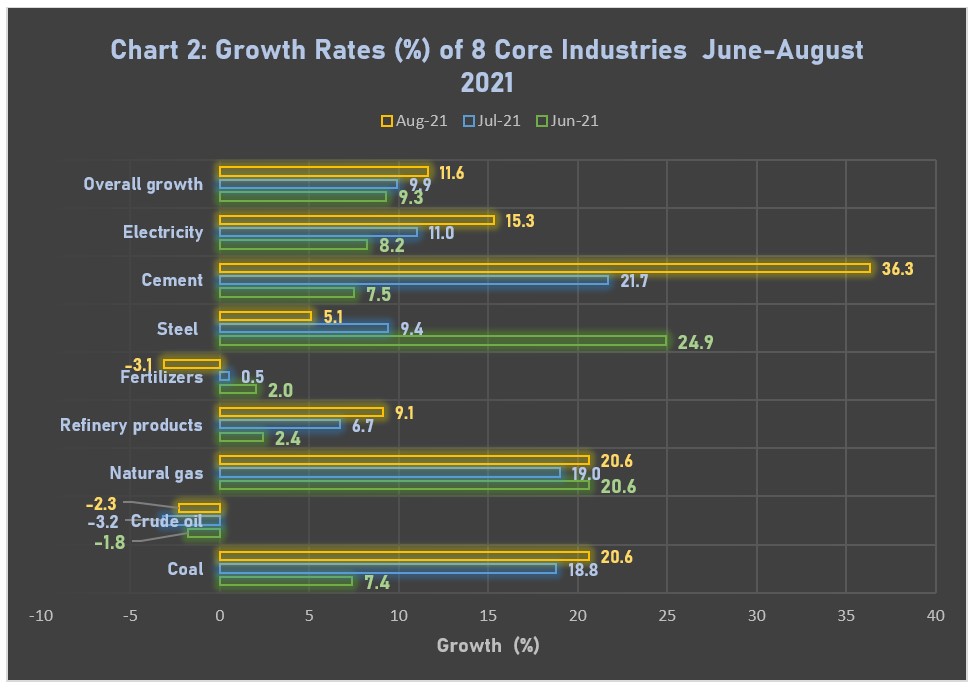
The core sector growth in August 2021 was mainly driven by cement at 36.3% (compared to 21.7% in July and 7.5% in June 2021), natural gas at 20.6% (compared to 19% in July and 20.6% in June 2021), coal at 20.6% (compared to 18.8% in July and 7.4% in June 2021), electricity at 15.3% (compared to 11% in July and 8,2% in Junto e 2021), and refinery products at 9.1% (compared to 6.7% in July and 2.4% in June 2021) (Chart 2).  The steel sector, however,  witnessed a steady slide in growth from 24.9% in June 2021 to 9.4% in July 2021 and 5.1% in June 2021. But, fertilizers (-3.1%) and crude oil sectors (-2.3%) suffered decline in August 2021.

The high core sector output growth in August 2021 possibly reflects the beginning of a period of a more elevated and sustainable growth trajectory of the core industries, due to higher growth in the economic sectors and the thrust of the government on investment in infrastructure as per the National Infrastructure Pipeline. Weak monsoon rains in August positively impacted the output for coal, cement and electricity. Also, it influenced the increase in  mobility that resulted in the growth in petroleum refinery products. However, excess rainfall during September could have an adverse impact on the growth of output in these sectors. Therefore, according to ICRA, core sector output in September may not be sustained, and  could fall sharply to 4-6%.

Source of data: Press Release dated September 30, 2021, Office of the Economic Adviser, Department of Promotion of Industry & Internal Trade, GoI
Posted in economics, Financial Markets

US Federal Reserve Prepares to Taper in November

Dr Debesh Roy, Chairman, InsPIRE

The Federal Open Market Committee (FOMC) at its meeting held on 22 September 2021, unanimously decided to maintain the rate of interest paid on reserve balances at 0.15% and also to continue with the federal funds rate in a target range of 0-0.25%, continuing with the accommodative stance.  While the FOMC decided for now to continue with quantitative easing (QE) of $120 bn-a-month asset purchase program, the Fed Chair Mr. Jerome Powell made it amply clear that “tapering” of the program could be initiated at the next FOMC meeting in November 2021.

The stimulus package was introduced at the onset of the pandemic, and the US Federal Reserve pledged to maintain it until there was substantial progress on its dual goals of average 2% inflation and maximum employment. The Fed believes that the US economy would be on a firm footing on these two counts, and would, therefore start the tapering exercise. Mr. Powell also revealed that the FOMC broadly supports a gradual tapering and intends to withdraw the stimulus entirely around the second half of 2022.

There is however, less unanimity among Fed members regarding tightening of interest rates, as the eighteen-member Committee is now evenly split on the prospects of a rate increase in 2022. There could be three rate hikes by the end of 2023.

Impact of Taper Decision by US Fed on Emerging Market and Developing Economies (EMDEs) like India

Financial markets globally, including India’s seem to have factored in the imminent gradual tapering exercise by the US Federal Reserve. Indian markets continued to surge, in spite of the almost certain tapering from November 2021. QEs with near zero interest rates in developed countries, led to massive flow of funds to emerging market economies.

The 2013 tapering by US Fed in the aftermath of the Global Financial Crisis, led to what is known as “taper tantrum”. In response to the statement by the then Fed Chair Dr. Ben Bernanke in May 2013, suggesting that the FOMC might soon start to slow down its bond purchases, the US 10-year bond yield surged and triggered a wave of capital flight from emerging economies. The countries affected the most from the “taper tantrum” were South Africa, Brazil, India, Indonesia and Turkey, which were dubbed the “fragile five” by Morgan Stanley due to their high current account deficits and dependence on inflows of foreign capital.

However, the situation is vastly different now, and “taper tantrum” can be ruled out in India. Foreign Institutional Investors (FIIs) have invested $8.94 billion in India so far in 2021. The Sensex and Nifty have gained 23-25% during the year. The effect of the tapering would be relatively low for India’s markets due to strong fundamentals, with a low current account deficit and a high and steadily growing foreign exchange reserves, which have touched a comfortable $640 billion (as on 17 September 2021). While high inflation is a problem, it is transient in nature, as underscored by the Reserve Bank of India.  

The EMDEs must certainly remain vigilant and take necessary monetary and fiscal measures to prevent taper to turn into a “tantrum” to cause any major outflow of liquidity from these economies.

Posted in agriculture, economics

Oilseeds and Commercial Crop Production in India – Kharif 2021-22

Dr Debesh Roy, Chairman, InsPIRE

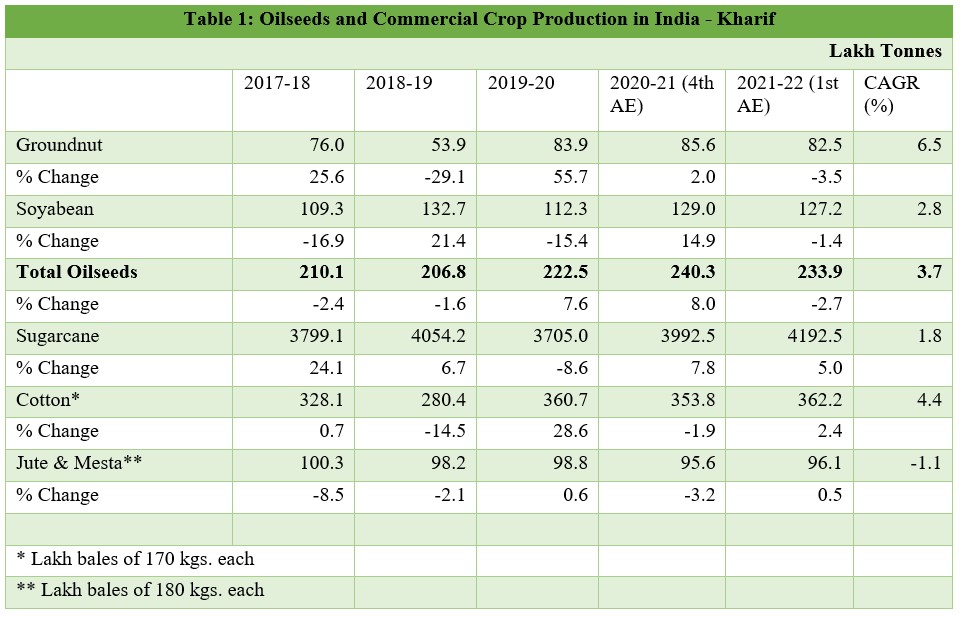
The estimated production of oilseeds is set to decline by -1.4% to 233.9 lakh tonnes (LT) in Kharif 2021-22, from 240.3 LT in 2020-21, due to a decline in acreage by -1.3% (Table 1 and Chart 1). The five-year CAGR of oilseeds production is estimated to be 3.7%. India’s demand for oilseeds is mostly met through imports. Therefore, Government of India’s decision to launch the National Mission on Edible Oils – Oil Palm (NMEO-OP), a Centrally Sponsored Scheme, is expected to significantly increase acreage and output of oilseeds in the country.

Among major oilseeds, groundnut and soyabean are expected to experience decline in output in kharif 2021-22. Groundnut output is estimated to decline by -3.5% to 82.5 LT, due to -3.6% decline in area under cultivation (Table 1 and Chart 1). The five-year CAGR of groundnut production is estimated to be 6.5%. It is estimated that soyabean production would decline by -1.4% to 127.2 LT, although there has been a marginal increase of 0.5% in acreage. Soyabean output would grow at a five-year CAGR of 2.8%.

Commercial crops like sugarcane and cotton are expected to perform better than the previous year. Sugarcane production is estimated to grow at  5% over the previous year to set a record of 4192.5 LT, on account of 1.6% increase in acreage. The output of cotton is expected to increase by 4.4% to 362.2 lakh bales, although there has been a significant decline of -5.8% in the area under cultivation, signifying an improvement in productivity. Finally, the output of Jute and Mesta is expected to decline by -1.1% to 96.1 lakh bales, although there has been an increase of 1% in acreage (Table 1 and Chart 1).

Source: First Advance Estimates of Production of Foodgrains for 2021-22, Ministry of Agriculture
and Farmers’ Welfare, GoI, and calculations by InsPIRE.
Source: Prepared by InsPIRE, based on data accessed from First Advance Estimates of Production of Foodgrains for 2021-22, and Progress Report of Kharif Area Coverage as on 17/09/2021, Ministry of Agriculture and Farmers’ Welfare, GoI.
Posted in agriculture, economics

New Milestone of 150.5 MT Kharif 2021-22 : Estimated Foodgrain Output  

Dr Debesh Roy, Chairman, InsPIRE

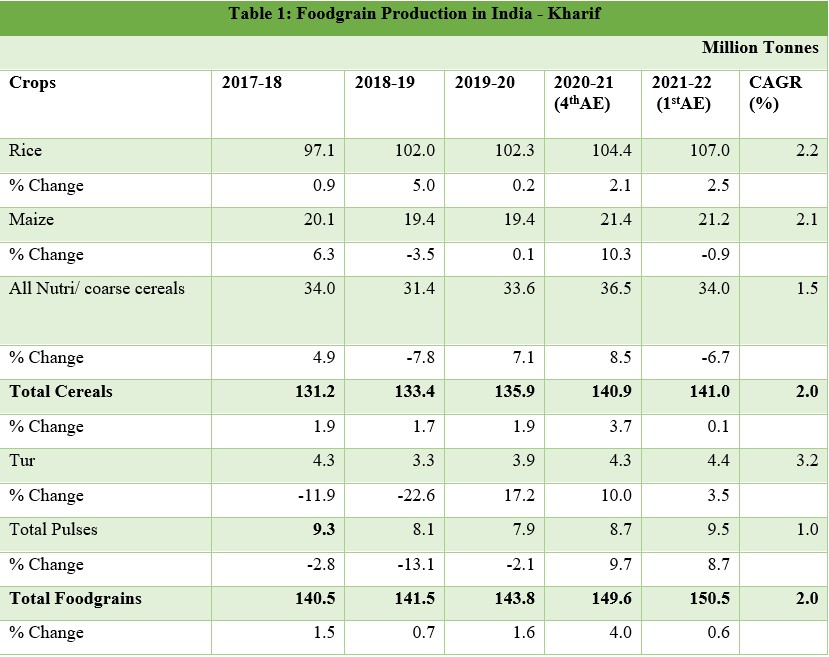
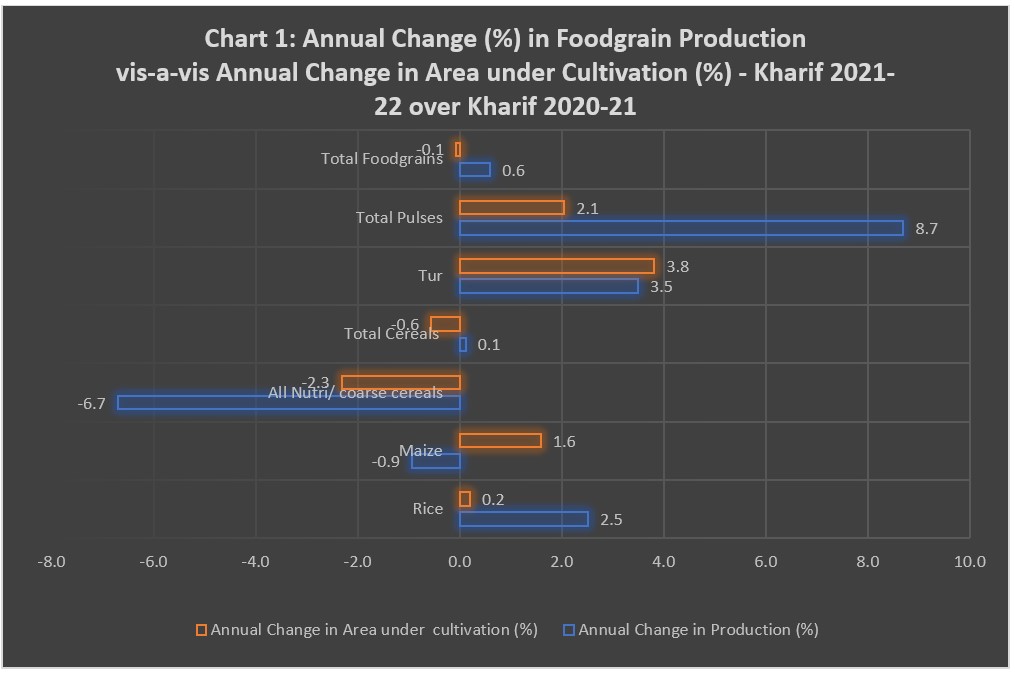
India’s foodgrain production for the kharif season 2021-22 is estimated to reach a record 150.5 million tonnes (0.6% increase over 2020-21, albeit a decline in acreage of -0.1%), while growing at a five-year CAGR of 2% (Table 1 and Chart 1). This was mainly on account of increased area under cultivation of rice and pulses (mainly tur or arhar). The estimated increase in acreage under these crops was facilitated by a surge in monsoon rains in September 2021.

The output of kharif rice is estimated to touch a record 107 million tonnes (MT), registering a growth of 2.5% over the previous year (Table 1). However, the area under cultivation of rice has increased marginally by 0.2% over 2020-21 (Chart 1), signifying efficiency gains in the cultivation of the crop. During the last five years, the production of kharif rice has grown at a CAGR of 2.2% (Table 1). Maize, with an estimated output of 21.2 MT, has experienced -0.9% annual change in production, against a 1.6% increase in area, signifying a decline in yield. The five-year CAGR of maize output stood at 2.1%. Nutri/ coarse cereals as a whole have witnessed significant decline in the estimated output by  -6.7% and acreage by -2.3%.

While the estimated output of tur (4.4 MT) increased  by 3.5%, acreage increased by 3.8%. The production during the last five years increased by an impressive CAGR of 3.2%. The estimated output of pulses as a whole (9.5MT), increased significantly by 8.7% over the previous year, while the acreage had increased by 2.1% (Chart 1), indicating an increase in yield, The five-year CAGR of pulses stood at 1% (Table 1).

Source: First Advance Estimates of Production of Foodgrains for 2021-22, Ministry of Agriculture
and Farmers’ Welfare, GoI, and calculations by InsPIRE.
Source: Prepared by InsPIRE, based on data accessed from First Advance Estimates of Production of Foodgrains for 2021-22, and Progress Report of Kharif Area Coverage as on 17/09/2021, Ministry of Agriculture and Farmers’ Welfare, GoI.
Posted in economics, Financial Markets

SENSEX at 60K+ : Hitting the “Bull’s” Eye

Bijetri Roy, Managing Director & Chief Strategy Officer, InsPIRE

SENSEX closed at 60,048.47 on 24th September, 2021, ear-marking a high in the graphs, since the last milestone of 50,255.75 on 3rd February, 2021. In fact, even the BSE Realty and NIFTY IT indices closed at their respective highs of 4002.46 and 37,103.25.

This is a clear indication that India is still the flavour of the season, despite a probable slowdown in China or smaller bond purchase by central banks.

Earlier this week, Sanjeev Prasad, Kotak Institutional Equities said, “We expect a strong economic and earnings revival and a stable COVID-19 situation to provide short-term support to the market. We do not see any change to India’s medium-term narratives, including favourable demographics and likely multi-year investment cycle led by corporate and household capital expenditure.” (Source: Financial Express)

In the last four seasons, Domestic Institutional Investors (DIIs) invested in shares worth USD 1 billion, while Foreign Portfolio Investors (FPIs) invested in Indian equity worth USD 9 billion. (Source: Financial Express)

According to Piyush Garg, Chief Investment Officer at ICICI Securities Ltd, “Indian stocks have been performing well over the past few quarters due to robust liquidty, upward earnings cucle and an economic revival led by a fading pandemic. (Source: Mint Lounge)

Infographic designed by Institute for Pioneering Insightful Research & Edutech Pvt Ltd (InsPIRE)

“SENSEX reaching 60,000 shows India’s growth potential and its emergence as a world leader, amid Covid”, Ashish Chauhan, MD & CEO, BSE.

However, looking at the global markets at present, investors should be cautious of the following:

  • Rising inflation
  • Subsequent squeeze in liquidity

Overall, India is definitely the flavour of the season, having hit the “bull’s” eye with the 60K milestone.

Posted in economics

Evergrande Crisis in China

Bijetri Roy, Managing Director & Chief Strategy Officer, InsPIRE

Crisis ridden Evergrande is one of China’s largest real estate developers and is also the most indebted. The crisis has raised alarm bells across the globe. Financial Times has reported that the company used billions of dollars raised by selling wealth management products to retail investors to plug funding gaps and even to pay back other wealth management investors. It is also reported that Evergrande financial advisers marketed the products widely, including to homeowners in its apartment blocks, while its managers persuaded subordinates to invest.

Evergrande owes money to thousands of retail investors along with banks, suppliers and foreign investors, who fear they will not be repaid if the property group collapses. The Rmb 40 billion of wealth management products of Evergrande is dwarfed by its total of liabilities of Rmb2 trillion (USD 310 billion) (Source: Financial Times).

Evergrande’s total debt exposure (USD 310 billion)  includes USD19 billion in offshore dollar-denominated bonds. The group has expressed that it might default on USD 80 million worth of interest payments due within a week. This would not only  have ripple effects within China but the global economy as well. There are 128 banks and about as many financial institutions have direct exposure to Evergrande. A large number of these institutions could take big hits if the company collapses, sending shock waves across global markets. A tightening of controls by the People’s Bank of China and a weakening of housing demand has resulted in this crisis.

There is a view among a section of experts that the crisis is reminiscent of the Lehman crisis of the US in 2008, which triggered the Global Financial Crisis. However, a contrarian viewpoint is gaining support. According to a team at Barclays led by Ajay Rajadhyaksha, the two crises could not be more different. They argued: “the property sectors’ linkages to the financial system are not on the same scale as a large investment bank, but the debt capital markets are not the only, or even the primary, means of funding. China is to a large extent, a command-and-control economy. In an extreme scenario, even if the capital  markets are shut to all Chinese property firms, regulators could direct banks to lend to such firms, keeping them afloat and providing time for an extended ‘work-out’ if needed.

The only way to get a widespread lenders’ strike in a strategically important part of the economy would be if there were a policy mistake, where the authorities allow the chips to fall where they may (perhaps to impose market discipline), regardless of the systemic implications. And we think that’s very unlikely; the lesson from Lehman was that moral hazard needs to take a back seat to systemic risk. We don’t mean to imply that China has succeeded in suspending the laws of economics. If an asset can’t fully service the underlying debt, it of course matters. But the economics can show up through either a one-time (violent) balance sheet adjustment – aka a financial crisis – or through many quarters of income statements (a debt bubble being deflated).

We also don’t mean to suggest that China could never have a Lehman moment. But with the banking system likely to be pressed into service as a funding source in the event of real stress, China would likely face a ‘true’ financial crisis only if its banks had funding problems. This risk was high in 2015, when the country saw over a trillion dollars of capital flight, meaning there was something of a ‘run’ on the domestic financial markets as a whole”. (Source: Financial Times).

Posted in economics

United States Retail Inflation – August 2021

Bijetri Roy, Managing Director & Chief Strategy Officer, InsPIRE

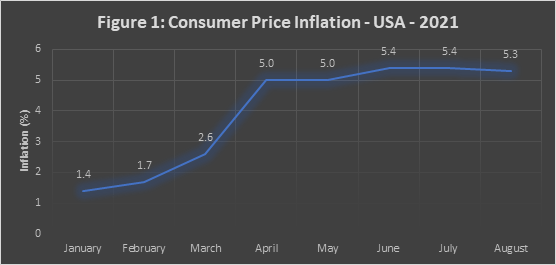
The US consumer price inflation has eased marginally to 5.3% in August 2021, compared to 5.4% in the previous month, as per the Bureau of Labor Statistics (Figure 1). The cooling of inflationary pressures is associated with the economic reopening from Covid-19 lockdowns, while still remaining near a 13-year high. Month-over-month price increase, too slowed, with an increase of 0.3% from July.

However, this is much lower than the 0.9% increase reported between May and June and a drop-off from the 0.5% rise from June to July. While inflation remained benign during January to March, it increased sharply to 5% in April and continued to remain elevated at 5% and above during April to August 2021 (Figure 1).

Source: Bureau of Labor Statistics, USA

Core inflation, which excludes volatile items such as food and energy, also declined. The monthly figure for August fell to 0.1%, which was the smallest increase since February 2021. On a year-over-year basis, core inflation declined to 4% from 4.3% in July.

Inflation in the US during the current year has been mainly influenced by price rises in sectors most sensitive to supply bottlenecks and other pandemic-related disruptions. The inflation data for July revealed the initial signs of the abating of price increases, especially in respect of used car and truck prices and travel expenses, which have been the major drivers of inflation.

The inflation print corroborates with the view of the US Federal Reserve about inflation being transitory in nature.

According to the August 2021 Survey of Consumer Expectations of the Federal Reserve Bank of New York short- and medium-term inflation expectations increased to new series highs of 5.2% and 4.0%, respectively. Home price growth expectations continued to moderate in August but remain elevated. Households’ perceptions about their current financial situations improved, and income growth expectations rose to a new series high.